
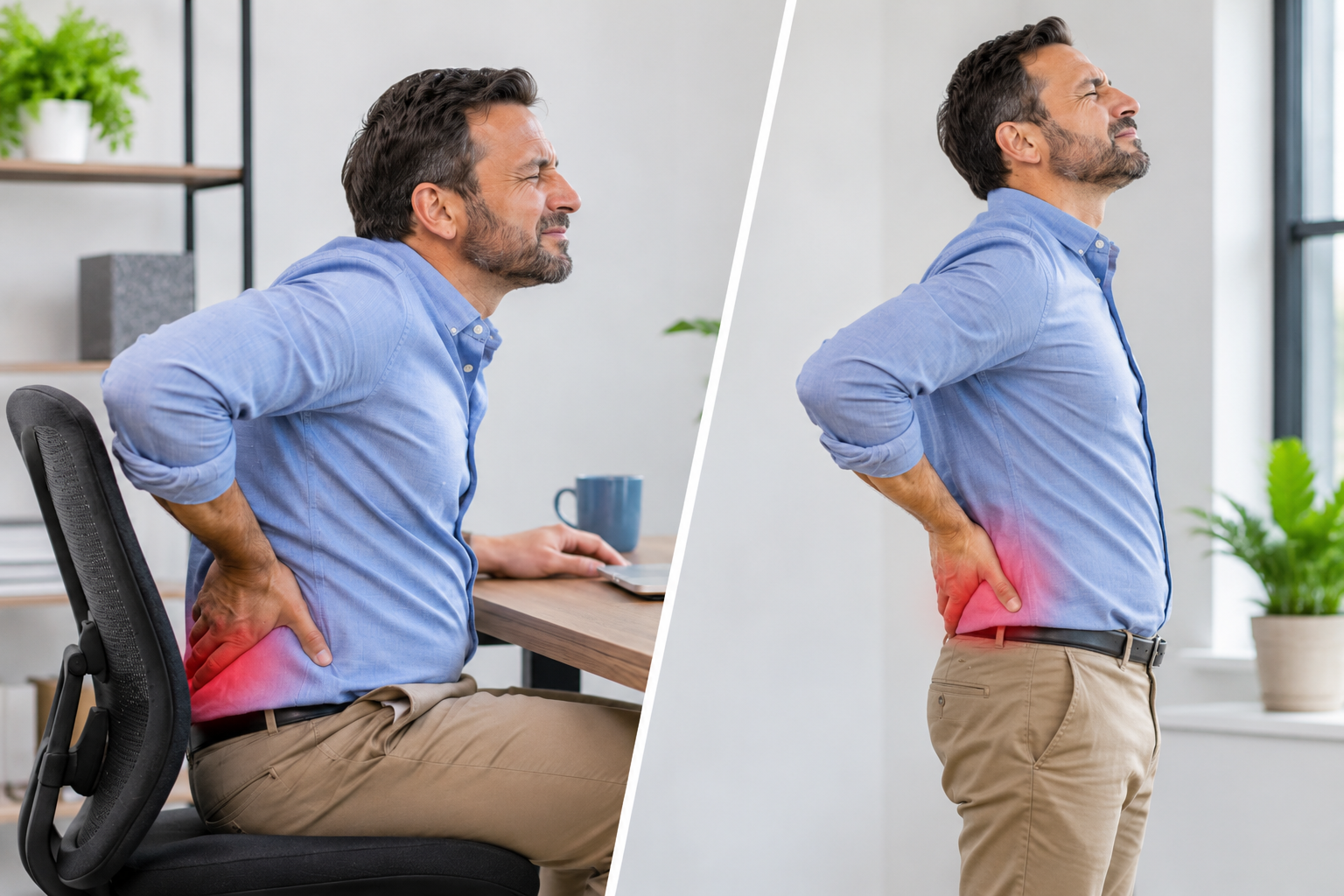
Back pain changes with position because each posture loads a different part of the spine. Sitting raises pressure inside the lumbar discs, so disc problems often flare in a chair. Standing and walking extend the lower back, which narrows the spinal canal and compresses the facet joints, so stenosis and joint arthritis tend to flare on your feet. That pattern is one of the most useful clues a specialist uses to plan back pain treatment in Philadelphia, PA.
Here is the part most people miss: the position that hurts is often more telling than how much it hurts. A commuter who aches on SEPTA but feels fine on a walk along the Schuylkill likely has a different problem than someone who has to sit down halfway through a Reading Terminal Market lap. Below, we break down each pattern, what it may point to, and when it is time to get checked.
Back Pain When Sitting: What It May Point To
Back pain when sitting usually points to the discs at the front of the spine. When you sit, especially slouched, the lumbar spine bends forward and squeezes the discs more than when you stand. A damaged or bulging disc then presses harder on nearby nerves.
Common signs of a sitting-sensitive problem:
- Pain builds the longer you sit and eases once you stand and move.
- Getting up from a chair or car seat is stiff or sharp.
- Coughing, sneezing or bending forward makes it worse.
- Pain, tingling or numbness runs into the buttock or down one leg.
That last sign matters. Leg symptoms with sitting often suggest a herniated disc irritating a nerve root, which can show up as sciatica. Sitting pain on one side, low near the buttock, can also come from the sacroiliac (SI) joint.
Lower Back Pain When Standing: What It May Point To
Lower back pain when standing usually points to the back of the spine: the facet joints and the spinal canal. Standing upright arches the lower back slightly, which loads the facet joints and shrinks the space nerves pass through.
Common signs of a standing-sensitive problem:
- An ache across the low back after standing in one spot, like a long shift, a kitchen counter or a line at the Linc.
- Relief from sitting, leaning on a counter or bending slightly forward.
- Stiffness that is worst in the morning and loosens with gentle movement.
- Pain that worsens when you lean back or twist.
These patterns often fit facet joint arthritis or early spinal stenosis. Weak core muscles and posture habits can add to the load, but they rarely explain persistent pain on their own.
Back Pain While Walking: The Pattern That Says the Most
Back pain while walking, with heaviness or cramping in the buttocks or legs, is the classic sign of lumbar spinal stenosis. Doctors call it neurogenic claudication. Each upright step keeps the canal narrow, so pressure on the nerves builds until you have to stop.

The tell-tale clues:
- You can walk a set distance, such as two or three blocks, before your legs feel heavy or numb.
- Sitting down or bending forward brings relief within minutes; just standing still does not.
- Leaning on a shopping cart or walker lets you go farther.
- Walking downhill is harder than walking uphill.
The Merck Manual explains that leaning forward helps because the lumbar canal is wider in flexion and narrower in extension. One caution: leg pain on walking can also come from poor blood flow to the legs. If rest alone, not a change of position, eases it, a circulation check belongs in your workup.
Back Pain When Sitting vs Standing: Quick Comparison
Sitting pain tends to come from the front of the spine (discs); standing and walking pain tends to come from the back of the spine (facet joints and canal). Use this table to match your own pattern before your visit.
| Pattern | Worse with | Better with | Possible causes |
| Sitting | Long drives, desk work, bending, coughing | Standing, walking, lying flat | Herniated or bulging disc, sciatica, SI joint dysfunction |
| Standing | Standing still, leaning back, twisting | Sitting, leaning forward | Facet joint arthritis, early spinal stenosis |
| Walking | Distance, downhill, upright posture | Sitting, bending forward, leaning on a cart | Lumbar spinal stenosis (neurogenic claudication) |
| All positions, plus night pain | Rest and activity alike | Little changes it | Needs prompt evaluation to rule out non-mechanical causes |
Many people fit more than one row. A disc problem and stenosis can exist together, which is exactly why a hands-on exam matters more than a self-check.
How Symptom Patterns Guide Back Pain Treatment in Philadelphia, PA
Your position pattern narrows the list of likely causes, and the cause decides the treatment. At MVM Health’s Philadelphia, PA location, an evaluation usually follows three steps:
- History. Which position hurts, how far you can walk, whether pain travels into a leg, and what eases it.
- Physical exam. Movement tests in bending and arching, nerve and reflex checks, and strength testing in the legs.
- Imaging when needed. MRI or X-ray confirms what the history and exam suggest; it is not the first step for everyone.
From there, care is matched to the source. Disc-related nerve pain may respond to physical therapy and epidural steroid injections. Facet joint pain that flares when standing may be treated with targeted injections or radiofrequency ablation (RFA). Stenosis that limits walking may combine flexion-based exercise, injections and, for persistent cases, advanced minimally invasive options.
The goal is simple: treat the structure causing the pain rather than the pain alone. Read more on our Back Pain condition page.
Get Your Back Pain Pattern Checked in Philadelphia
The chair, the counter or the sidewalk you keep avoiding is already telling a story about your spine. A focused evaluation turns that story into a clear diagnosis and a plan built around it.
When to See a Back Pain Specialist in Philadelphia, PA
See a back pain specialist in Philadelphia, PA if position-related pain lasts more than four to six weeks or keeps returning. Earlier is better when the pain starts shrinking your day: skipping the walk to work, standing at the back of a meeting, or avoiding long drives on I-95.
Book a visit soon if you notice:
- Pain, numbness or tingling that travels below the knee.
- The walking distance is getting shorter month by month.
- Leg weakness, such as a foot that catches or a knee that buckles.
- Pain that wakes you at night or does not change with any position.
Go to an emergency room right away for loss of bladder or bowel control, numbness in the groin or inner thighs, or sudden weakness in both legs. These can signal severe nerve compression that needs same-day care.
Searching “back pain treatment near me” from Center City, South Philly or the Northeast? Our Philadelphia team evaluates sitting, standing and walking pain in one visit.