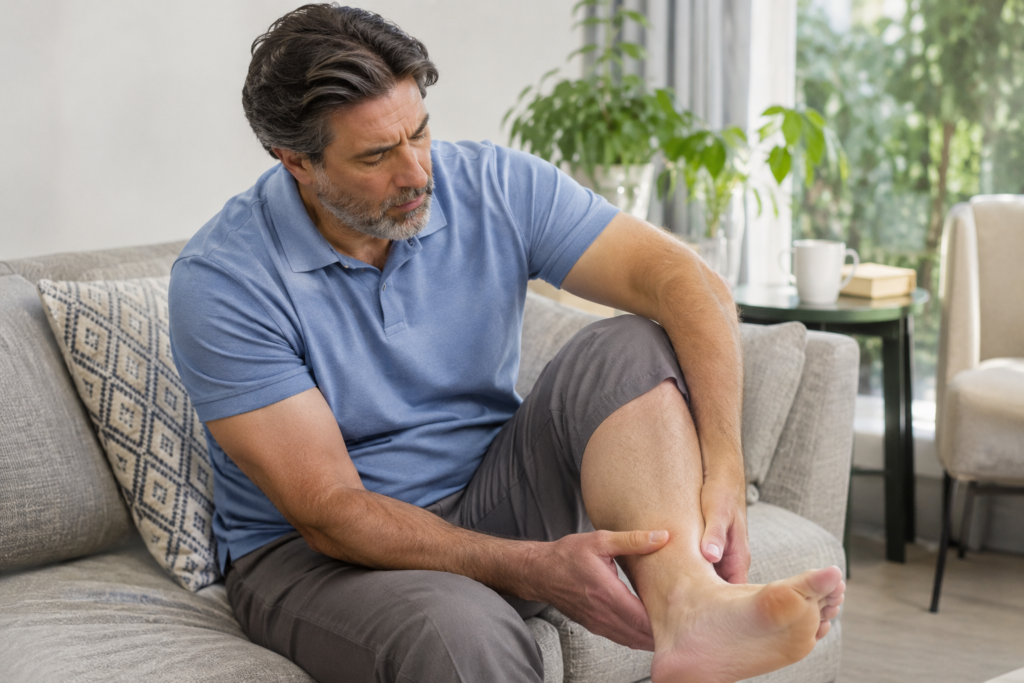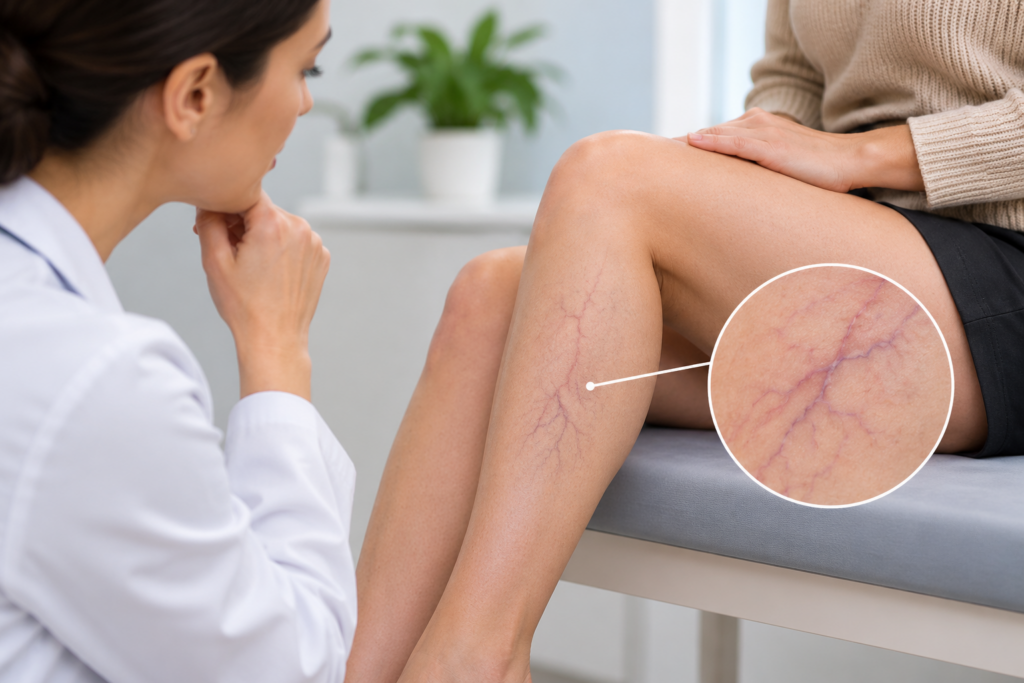

Knee pain on stairs is one of the most common early signs of a knee problem, and it most often points to knee osteoarthritis, irritation behind the kneecap, or a meniscus injury. Stairs put several times your body weight through the knee, so they expose problems that walking on flat ground can hide. Whether the pain shows up going up, going down, or both is an important clue to the cause.
Many people first notice it as a dull ache climbing to the second floor, or a sharp catch stepping down off a curb. At first it may only happen after a long day. Over time it can turn a simple flight of stairs into something you plan around, holding the railing tightly or leading with your “good” leg.
People experience knee pain on stairs in different ways:
- A dull ache around or behind the kneecap: often worse after sitting for a while.
- Sharp pain on the inner or outer side of the knee: sometimes with a catching or locking feeling.
- Stiffness: the knee feels tight and slow to bend, especially in the morning.
- Grinding or crackling: a gritty sensation as the knee bends.
- Weakness or giving way: a sense the knee might buckle, especially going down.
The good news is that most causes respond well to treatment, especially when addressed early. This guide explains why stairs are so hard on the knees, the most common causes, how to tell them apart, when to see a doctor, and what treatment can do.
Why Stairs Are So Hard on Your Knees
Stairs load the knee far more than level walking because the joint has to bend deeply while carrying your full body weight on one leg. Research on knee mechanics suggests forces through the joint can reach roughly three to four times body weight on stairs, compared with about one to two times on flat ground. The kneecap (patella) is pressed hard into its groove on the thighbone with every step.
Going up and going down stress the knee in different ways:
- Climbing up – the thigh muscles (quadriceps) contract to straighten a bent knee and lift your body. This compresses the kneecap against the thighbone and loads the cartilage at the front of the joint.
- Going down – the quadriceps lengthen while working to control your descent, like a brake. This “eccentric” work is demanding and puts high, sudden loads through the joint, which is why many people find going down more painful than going up.
Any weak link shows up under this load. Worn cartilage, a kneecap that tracks off-center, a torn meniscus, an irritated tendon, or weak hip and thigh muscles can all turn stairs into a pain trigger long before they cause trouble on flat ground. Extra body weight multiplies the effect: each extra pound adds several pounds of force to the knee on every step.
Knee Osteoarthritis: The Most Common Cause After 50
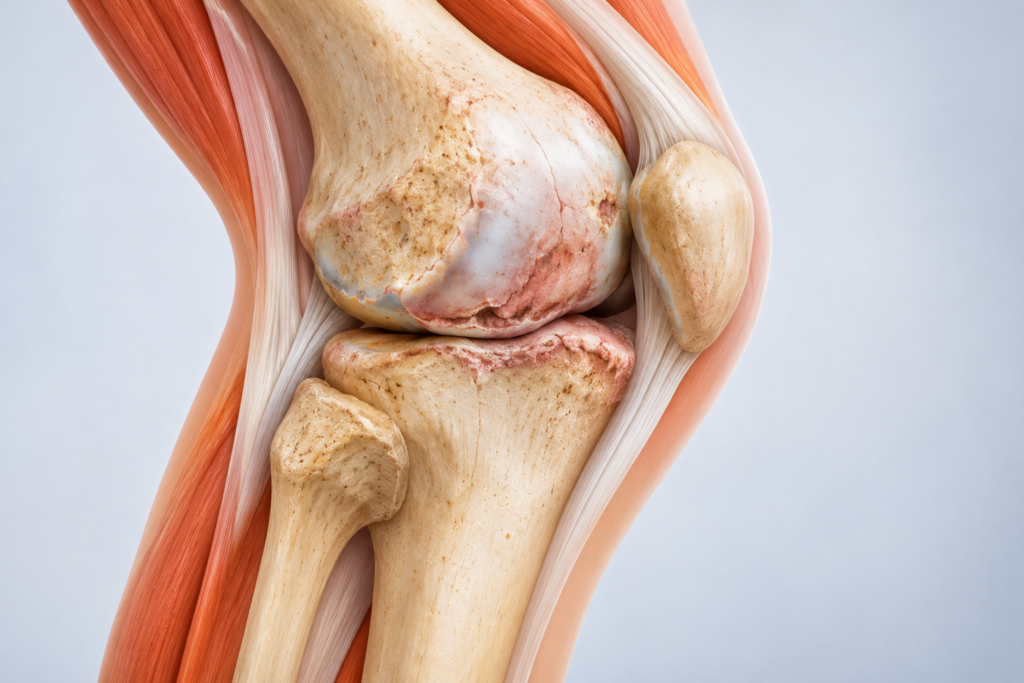
Knee osteoarthritis is the gradual wearing down of the cartilage that cushions the knee joint, and difficulty with stairs is often one of its first symptoms. As the smooth cartilage thins, the bones lose their shock absorber. The joint becomes inflamed, and small bony growths called bone spurs can form at the edges. Stairs, which concentrate force on the joint, are where people tend to notice this first.

What Knee Pain on Stairs Feels Like With Osteoarthritis
- A deep, aching pain in the knee during and after climbing or descending.
- Stiffness when starting to move, such as the first few steps after sitting, that eases a little once you get going.
- Grinding, creaking, or crackling as the knee bends.
- Swelling after a busy day or a long walk.
- Pain that is worse at the end of the day and improves with rest.
- In more advanced cases, a knee that looks enlarged or bowed, and pain that lingers at night.
Osteoarthritis can affect the inner side of the knee, the outer side, or the area behind the kneecap. When the kneecap compartment is involved, stairs and getting up from a chair are usually the hardest tasks of all.
Who is most at risk
- Age: risk rises steadily after 50.
- Excess weight: more load means faster cartilage wear. Losing even a modest amount of weight can noticeably ease knee pain.
- Previous knee injury: an old ligament or meniscus tear raises the risk years later.
- Sex: women are affected more often than men.
- Repetitive kneeling, squatting, or heavy lifting at work.
- Family history and joint alignment: bow-legged or knock-kneed alignment overloads one side of the joint.
The Outlook
Osteoarthritis can’t be reversed, but it can be managed very well. Strengthening, weight management, activity changes, and targeted treatments such as joint injections help many people keep using stairs comfortably for years. Knee replacement is reserved for severe cases that no longer respond to other care.
Patellofemoral Pain Syndrome (Runner’s Knee)
Patellofemoral pain syndrome is a common cause of knee pain on stairs, producing a dull ache around or behind the kneecap, especially when going down. It is the most common cause of knee pain in younger, active adults and teenagers, and it is more common in women. The problem lies in how the kneecap glides in its groove on the thighbone. When it is pulled slightly off-track or overloaded, the cartilage and soft tissue behind it become irritated.
Typical Signs
- Aching at the front of the knee rather than one side.
- Pain going down stairs, squatting, kneeling, or running downhill.
- The “moviegoer’s sign” – pain after sitting for a long time with the knees bent.
- A grinding or popping feeling under the kneecap.
- Usually no major swelling.
Common Causes
- Muscle weakness or imbalance: especially weak quadriceps and hip muscles, which let the knee drift inward on each step.
- Overuse: a sudden increase in running, hiking, stair workouts, or jumping.
- Tight muscles: tight hamstrings, calves, or the band of tissue on the outer thigh.
- Foot mechanics: flat feet or overpronation that change how force travels up the leg.
When the cartilage under the kneecap actually softens and breaks down, the condition is sometimes called chondromalacia patella. It causes similar symptoms and is treated in much the same way.
The outlook is good. Most people improve within a few months with a targeted program to strengthen the hips and thighs, adjust training load, and improve movement patterns.
Meniscus Tears
A torn meniscus can cause knee pain on stairs, particularly along the inner or outer side of the joint, accompanied by catching, locking, or swelling. The menisci are two C-shaped pads of cartilage that sit between the thighbone and shinbone and absorb shock. Stair climbing compresses and twists them under load, so a damaged meniscus tends to complain.
There are two main types of tear:
- Acute tears – usually in younger, active people after twisting the knee with the foot planted, as in sports. There is often a pop, followed by swelling over the next day.
- Degenerative tears – in people over 40, the meniscus weakens with age and can tear from a minor movement, such as squatting or stepping awkwardly. Many degenerative tears happen alongside early osteoarthritis.
Signs that point to a meniscus problem
- Pain along the joint line on one side, often the inner side.
- Pain when twisting, pivoting, or deep squatting.
- A catching or clicking sensation.
- Locking, where the knee gets stuck and won’t fully straighten.
- Swelling and stiffness.
Many meniscus tears, particularly degenerative ones, improve with physical therapy and time. A knee that truly locks, or a tear that keeps causing symptoms despite good conservative care, may need further evaluation by a specialist.
Other Causes of Knee Pain on Stairs
Several other conditions can make stairs painful, and some of them overlap with the causes above:
- Patellar tendinitis (jumper’s knee) – irritation of the tendon just below the kneecap. Pain sits at the bottom of the kneecap and is worse with stairs, jumping, and squatting.
- Quadriceps tendinitis – similar irritation of the tendon just above the kneecap, more common in middle age.
- Pes anserine bursitis – inflammation of a fluid-filled sac on the inner side of the knee, a few inches below the joint. It is common in people with osteoarthritis or excess weight and often hurts on stairs and at night.
- Prepatellar bursitis – swelling over the front of the kneecap, often from frequent kneeling.
- IT band syndrome – friction on the outer side of the knee from a tight band of tissue running down the outer thigh. It is common in runners and cyclists.
- Rheumatoid arthritis and other inflammatory arthritis – usually affects both knees and other joints, with morning stiffness lasting more than 30 minutes.
- Gout or pseudogout – crystal buildup that causes sudden, intensely painful, hot, swollen knees.
- Ligament injuries – a sprained or torn ACL, MCL, or other ligament can make the knee feel unstable, especially going down stairs.
- Referred pain from the hip or back – hip arthritis or a pinched nerve in the lower back can cause pain felt in the knee.
Going Up vs. Going Down: What Your Pain Pattern Means
The location of knee pain on stairs and whether going up or down hurts more can provide important clues to the underlying cause. Use this table as a guide, not a diagnosis.
Feature
| Feature | Knee osteoarthritis | Patellofemoral pain | Meniscus tear | Tendinitis / bursitis |
| Typical age | Over 50 | Teens to 40s | Any; degenerative tears over 40 | Any; bursitis more common over 50 |
| Where it hurts | Deep in the joint, often inner side | Front of knee, around or behind kneecap | Joint line, inner or outer side | Just above or below the kneecap, or inner knee below the joint |
| Worse going | Both, often down | Down | Both, with twisting | Up (tendon), both (bursa) |
| Other triggers | Standing up, long walks | Sitting with knees bent, squatting | Pivoting, deep squats | Jumping, kneeling |
| Stiffness | Morning or after rest, under 30 minutes | Mild | After activity | Mild |
| Swelling | Common after activity | Rare | Common | Local swelling over the bursa |
| Mechanical symptoms | Grinding | Grinding or popping | Catching, locking | Rare |
| Onset | Gradual, over months to years | Gradual, after training changes | Sudden (injury) or gradual | Gradual, after overuse |
In general, pain mainly going up stairs points toward the front of the knee and tendons doing the lifting work. Pain mainly going down points toward the kneecap joint and worn cartilage absorbing the impact. Many people with osteoarthritis feel both.
When to See a Doctor About Knee Pain on Stairs
Most cases of knee pain on stairs are not emergencies, but certain warning signs require prompt medical attention.
Seek urgent care if you have:
- A knee that is hot, red, and swollen, especially with fever or chills. This can signal a joint infection.
- Sudden, severe swelling after an injury, or a loud pop followed by the knee giving way.
- Inability to put weight on the leg or to straighten the knee.
- An obvious deformity after a fall or accident.
- Calf pain, swelling, and warmth along with knee pain, which can be a blood clot.
Book An Appointment if:
Knee pain on stairs lasts more than two to three weeks despite rest.
- You are holding the railing, leading with one leg, or avoiding stairs altogether.
- Your knee catches, locks, or gives way.
- Swelling keeps coming back.
- Pain wakes you at night or is present at rest.
- Over-the-counter pain relief no longer controls your symptoms.
- Knee pain is limiting your work, exercise, or independence.
How Doctors Diagnose Knee Pain on Stairs
Diagnosis usually starts with a careful history and hands-on exam, with imaging added only when it will change treatment.
History and Physical Exam
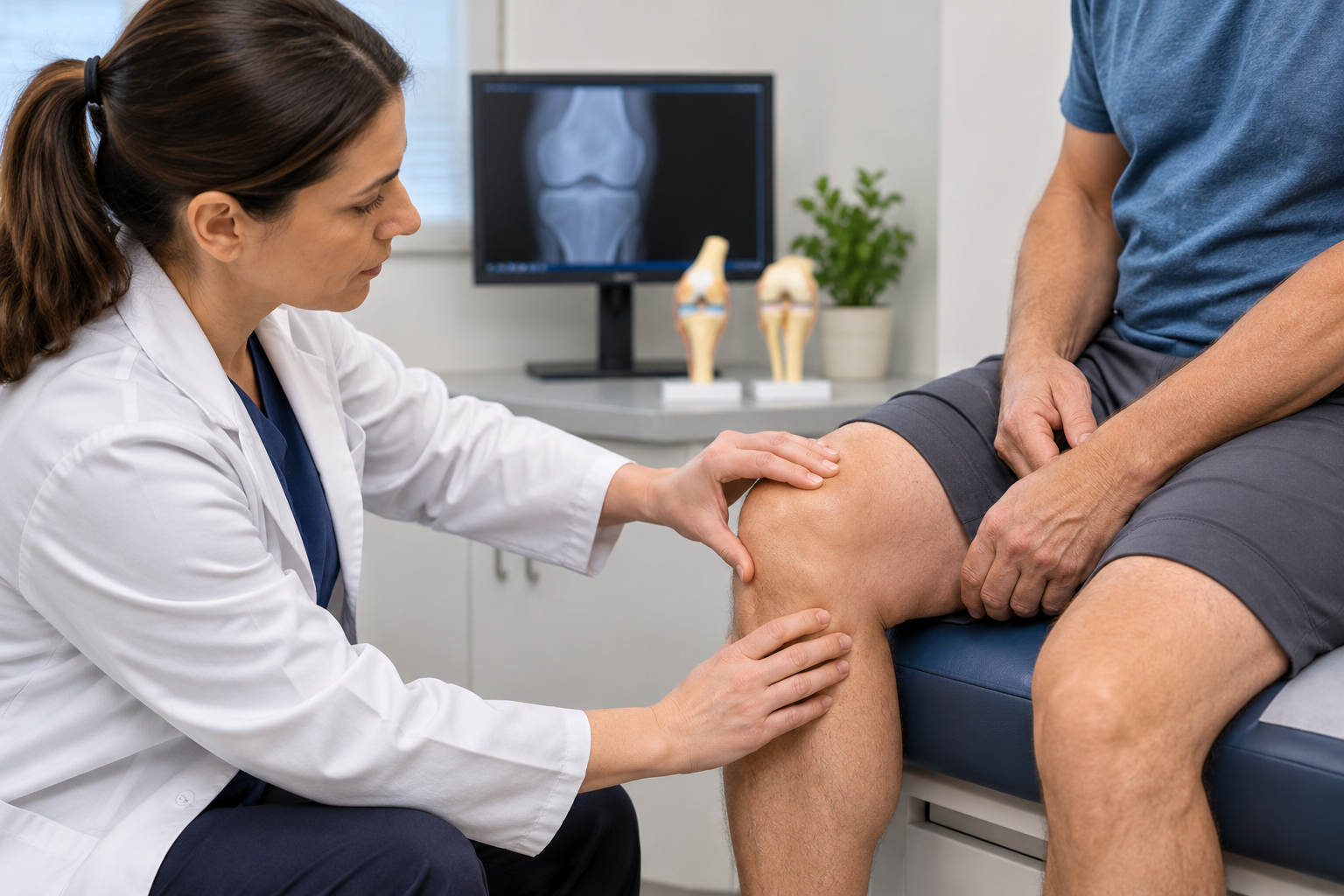
Your doctor will ask where the pain is, whether going up or down hurts more, how it started, and whether the knee swells, catches, or gives way. The exam checks for swelling, warmth, tenderness along the joint line and tendons, range of motion, kneecap tracking, and ligament stability. Your doctor may watch you squat, step down, or walk, and may check your hips and lower back too.
For osteoarthritis in particular, an experienced clinician can often make the diagnosis from symptoms and the exam alone. As the NIH’s InformedHealth guide notes, the typical early pattern is pain that appears when the joint is under strain and gradually becomes stronger and more frequent.
Common Tests
- X-rays – show joint space narrowing, bone spurs, and alignment. Standing X-rays are best for judging osteoarthritis.
- MRI – shows cartilage, the menisci, ligaments, and tendons. It is used when a tear or other soft-tissue injury is suspected.
- Ultrasound – useful for tendons, bursae, and fluid around the knee.
- Joint fluid analysis – fluid drawn from a swollen knee is tested for infection or crystals such as gout.
- Blood tests – check for inflammatory arthritis such as rheumatoid arthritis.
Find Relief From Knee Pain on Stairs
Don’t let knee pain on stairs limit your day. An evaluation at MVM Health can help identify the cause and guide treatment based on your symptoms and goals.
Treatment Options for Knee Pain on Stairs
Most people get significant relief without surgery, and treatment usually moves step by step from conservative care to targeted procedures.
First-line care
- Physical therapy and exercise – the most effective long-term treatment for most causes. Strengthening the quadriceps, hips, and core takes load off the knee and improves kneecap tracking.
- Activity changes – temporarily reducing stairs, deep squats, kneeling, or high-impact exercise while the knee settles, then building back gradually.
- Weight management – one of the most powerful tools for knee osteoarthritis. A medical weight loss program can help when diet and exercise alone haven’t worked.
- Medication – anti-inflammatory tablets or gels and acetaminophen for flare-ups, used as advised by your doctor.
- Supports – a knee sleeve, brace, or kneecap strap, plus supportive footwear or orthotics.
Injection-based treatments
- Corticosteroid injections – reduce inflammation and pain in an arthritic or irritated knee. Relief often lasts weeks to a few months.
- Hyaluronic acid injections – a gel-like fluid injected into the knee to improve lubrication in osteoarthritis.
- PRP and regenerative medicine – platelet-rich plasma from your own blood may support healing in some cases of osteoarthritis and tendon problems.
All of these are forms of joint injections, usually performed in the office, often with ultrasound guidance for accuracy.
Advanced non-surgical options
- Genicular nerve block and radiofrequency ablation (RFA) – the small nerves that carry pain signals from the knee are first numbed to confirm the source, then treated with controlled heat. RFA can ease osteoarthritis pain for many months and is an option for people who want to delay or avoid surgery.
Surgery
- Arthroscopy – for a meniscus tear that causes true locking or doesn’t improve with therapy.
- Partial or total knee replacement – for severe osteoarthritis when pain and limitation persist despite other treatment.
How to Make Stairs Easier: Technique, Home Care, and Prevention
Small changes in how you use stairs, plus a few simple habits, can make a big difference while you work on the underlying cause.
Smarter stair technique
- “Up with the good, down with the bad” – lead with your stronger leg going up and your painful leg going down. This lets the healthier knee do the hardest work.
- Use the handrail – it can take a meaningful share of your body weight off the knee.
- Take one step at a time – bring both feet onto each step before moving on.
- Place your whole foot on the step – avoid pushing up from your toes.
- Keep your knee in line with your toes – don’t let it collapse inward.
- Slow down – controlled steps reduce impact, especially going down.
Helpful Exercises
Ask a physical therapist which exercises suit your knee, but these are commonly used:
- Straight-leg raises – strengthen the quadriceps without bending the knee.
- Side-lying leg lifts and clamshells – strengthen the hip muscles that keep the knee aligned.
- Wall sits or mini-squats – within a pain-free range.
- Step-ups on a low step – gradually build stair-specific strength.
- Hamstring and calf stretches – reduce tension around the knee.
- Low-impact cardio – cycling, swimming, or water walking keep the joint moving without pounding it.
Everyday Care
- Ice for 15 to 20 minutes after activity to calm swelling, or heat before activity to ease stiffness.
- Maintain a healthy weight – less load on every step.
- Wear cushioned, supportive shoes and avoid high heels.
- Plan your day to reduce unnecessary trips up and down stairs during a flare-up.
- Stay active – complete rest weakens the muscles that protect the knee.