
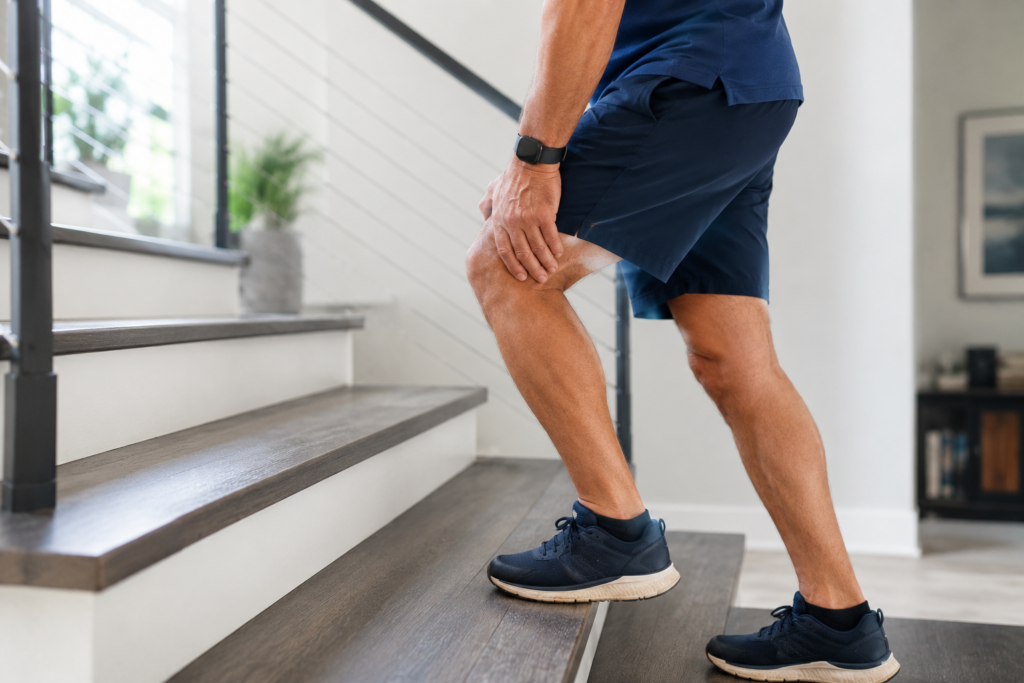
If you’re dealing with knee pain on stairs in Reading, PA, the most common causes are patellofemoral pain syndrome, a meniscus tear, early osteoarthritis, or patellar tendinitis. Each one puts extra pressure on the kneecap or joint cartilage once your knee bends under full body weight.
Which one you’re dealing with usually comes down to where the pain sits, when it started, and whether it comes with swelling, clicking, or stiffness.
If you live in Reading and dread the staircase in your own home, you’re not imagining things. Stairs ask more of your knees than almost any other daily movement.
So why does one flight leave your knee aching while a walk around the block feels fine? It comes down to how your kneecap tracks, how much cartilage cushion you have left, and how much load your quadriceps and hips can absorb before the joint takes the hit.
This kind of knee pain going up stairs shows up in a recognizable pattern for a lot of people in Reading, whether it’s the stairs at home, the parking garage, or the office. Once you understand what’s happening inside the joint, it’s easier to fix the problem instead of just working around it.
Why Stairs Are So Hard on Your Knees
Every time you take a step up, your body weight shifts entirely onto one leg, and your knee bends to roughly 60 to 90 degrees while carrying that full load. That motion presses the kneecap firmly into the groove of your thighbone.
Research on patellofemoral joint mechanics, detailed by the American Academy of Orthopaedic Surgeons, shows this compressive force can climb to several times your body weight during stair climbing alone, far beyond what standing or walking demands.
Going down tends to hurt more for a lot of people, and there’s a real mechanical reason for that. Descending requires your quadriceps to work eccentrically, meaning the muscle lengthens under tension to control your descent.
That loading puts even more compressive stress on the kneecap than climbing up does, which is part of why runner’s knee often flares up worse going downhill or downstairs.
None of this causes a problem if your cartilage is healthy and your kneecap tracks the way it should. But once there’s wear, inflammation, or a muscle imbalance involved, stairs are usually the first place it shows up, often before flat walking or light jogging ever give you trouble.
Common Causes of Knee Pain Going Up Stairs
There isn’t just one reason stairs single out your knees. A handful of conditions tend to show up again and again, and each one has its own pattern of pain, triggers, and warning signs.
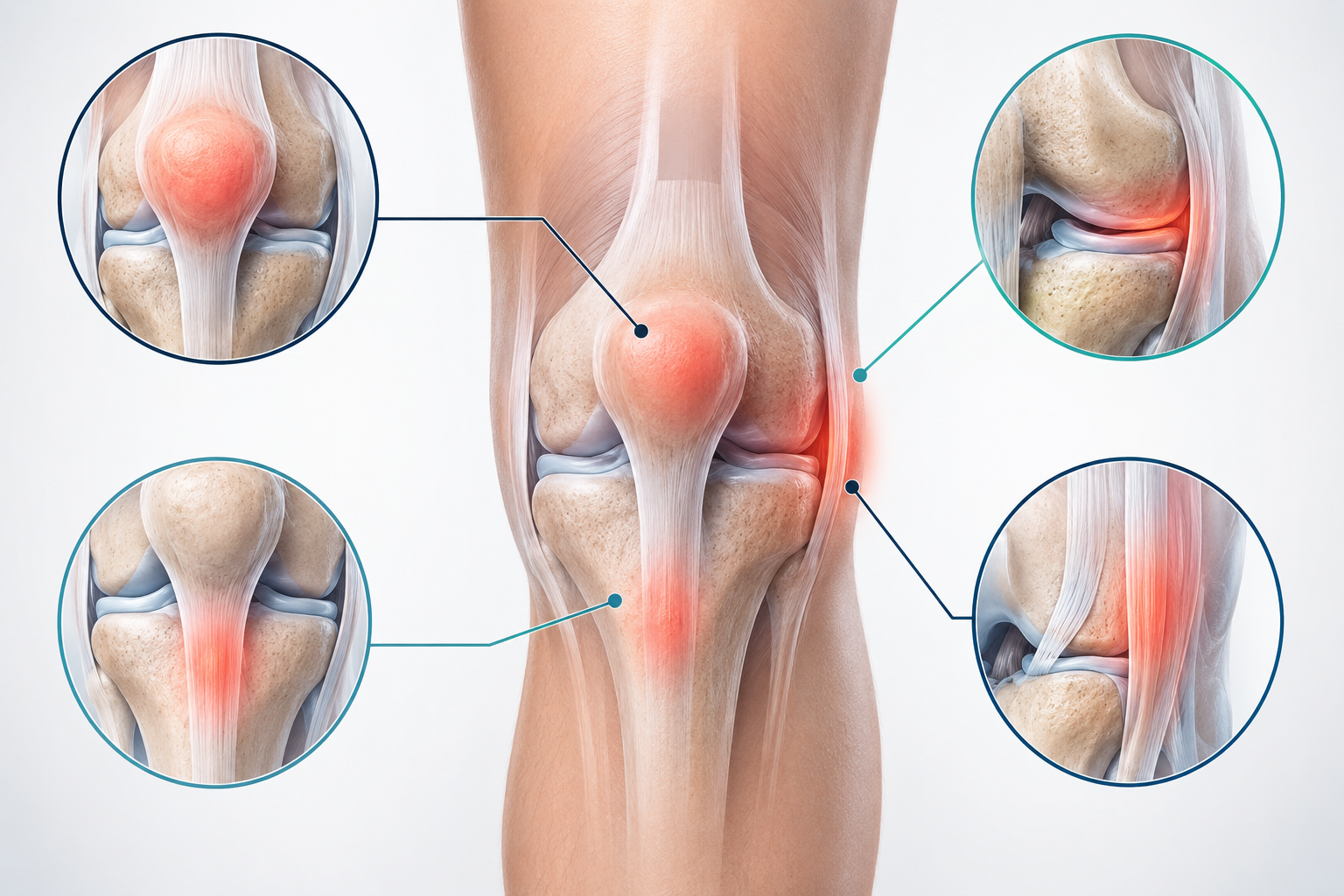
1. Patellofemoral Pain Syndrome (Runner’s Knee)
This is one of the most common reasons people in Reading, PA bring knee pain on stairs to their doctor. According to the American Academy of Orthopaedic Surgeons, it develops when the kneecap stops gliding smoothly within its groove, often from muscle imbalances, tight hamstrings, flat feet, or repetitive stress.
The pain usually sits right behind or around the kneecap and tends to worsen after sitting a while with the knee bent, sometimes called the “theater sign.”
Teens through people in their thirties are affected at higher rates, and women tend to develop this more often than men, largely due to hip and knee alignment differences.
2. Meniscus Tears
The meniscus is a C-shaped cushion of cartilage between your thighbone and shinbone, and each knee has two. A tear can happen suddenly, from a twisting injury, or gradually, as the cartilage becomes more brittle over years.
Either way, it usually shows up as sharp, localized pain when bending the knee, sometimes with catching, locking, or an audible click on stairs.
Unlike patellofemoral pain, this discomfort tends to sit along the joint line rather than behind the kneecap. If you’re managing a meniscus tear without surgery, see our guide on non-surgical recovery options for a meniscus tear for more detail.
3. Osteoarthritis and Patellofemoral Arthritis
As cartilage wears down over months or years, the bones underneath start making more direct contact, and that friction becomes especially noticeable on stairs. Patellofemoral arthritis targets the kneecap portion specifically.
It tends to bring stiffness after resting, along with a dull, grinding ache that builds through the day. It’s most common after age 50, though it can show up earlier with a history of knee injury or high-impact activity.
4. Patellar Tendinitis (“Jumper’s Knee”)
This is inflammation of the tendon connecting the bottom of your kneecap to your shinbone. It shows up often in people who are consistently active or who recently ramped up training, whether running, jumping sports, or extra stairs.
The pain concentrates in a specific spot just below the kneecap and worsens with repeated bending, stairs included.
5. IT Band Syndrome
The iliotibial band is a thick strip of connective tissue running along the outside of your thigh, from the hip down past the knee. When it tightens or gets inflamed, often from overuse or weak hip muscles, it can rub against the outer knee joint with every bend.
That produces pain sharpest along the outside of the knee, and it often flares up more during stair descent than ascent.
6. Chondromalacia Patella
This is the softening and gradual breakdown of the cartilage lining the underside of the kneecap. Cartilage has no nerve endings, so the pain actually comes from surrounding tissue reacting to the inflammation.
It shows up almost exclusively during movements that compress the kneecap directly, making stairs, squats, and kneeling the classic triggers.
7. Bursitis and Soft Tissue Irritation
Small fluid-filled sacs called bursae cushion the areas around your knee, and repeated friction from stairs or kneeling can inflame one of them. Prepatellar bursitis, for instance, causes swelling and tenderness at the front of the kneecap.
It mimics other conditions closely enough that it’s often misdiagnosed without a proper exam.
Comparing the Most Common Causes
| Condition | Where the Pain Sits | Common Trigger | Who’s Typically Affected |
| Patellofemoral Pain Syndrome | Front/around kneecap | Prolonged sitting, stairs, squats | Active adults, especially women |
| Meniscus Tear | Deep inside the joint line | Twisting, bending, catching | Athletes, adults over 40 with wear |
| Osteoarthritis | Whole joint, worse after rest | Stairs, inclines, standing long | Adults 50+ |
| Patellar Tendinitis | Just below the kneecap | Jumping, repeated stair use | Runners, jumpers, active adults |
| IT Band Syndrome | Outside of the knee | Downhill walking, stair descent | Runners, cyclists |
| Chondromalacia Patella | Under the kneecap | Squatting, kneeling, stairs | Teens, young adults, athletes |
| Bursitis | Front of kneecap, swollen | Kneeling, repeated bending | Anyone with repetitive knee stress |
Care Tip: Pay attention to which direction bothers you more, climbing up or coming down. That one detail often points a provider toward the right cause faster than the pain description alone.
Risk Factors for Knee Pain on Stairs
A handful of overlapping factors raise the odds of stair-related knee pain, no matter which specific condition ends up being the cause. Carrying extra body weight adds directly to the compressive load on the joint with every step.
Sudden bursts of activity after a sedentary stretch, like yard work after a week at a desk, put stress on muscles that haven’t been conditioned for it. Old knee injuries can also leave subtle changes in alignment that resurface years later, and unsupportive shoes change how force travels up through your leg.
When Should You See a Doctor for Knee Pain Going Up Stairs?
Some soreness after a long day on your feet isn’t usually cause for concern, and it tends to resolve with rest. But if knee pain on stairs has become a regular pattern, it’s worth getting checked if you notice:
- Swelling that doesn’t go down within a day or two
- A locking or catching sensation inside the joint
- Pain that wakes you up at night or disrupts sleep
- Instability, like your knee “giving way” unexpectedly
- Visible bruising or deformity following an injury
- Symptoms lasting longer than two to three weeks despite rest and modification
Putting off these signs often turns a manageable issue into something more complicated. If you’re not sure which specialist fits your symptoms, choosing the right knee pain doctor can help match your situation to the right provider.
How Pain Specialists Diagnose Stair-Related Knee Pain
A good diagnosis starts with more than just describing where it hurts. A physical exam checks your range of motion, joint stability, muscle strength, and how your kneecap tracks as you bend and straighten your leg.
The provider will also ask when the pain started, whether it followed an injury, and what makes it better or worse. These details narrow down the list of likely causes considerably.
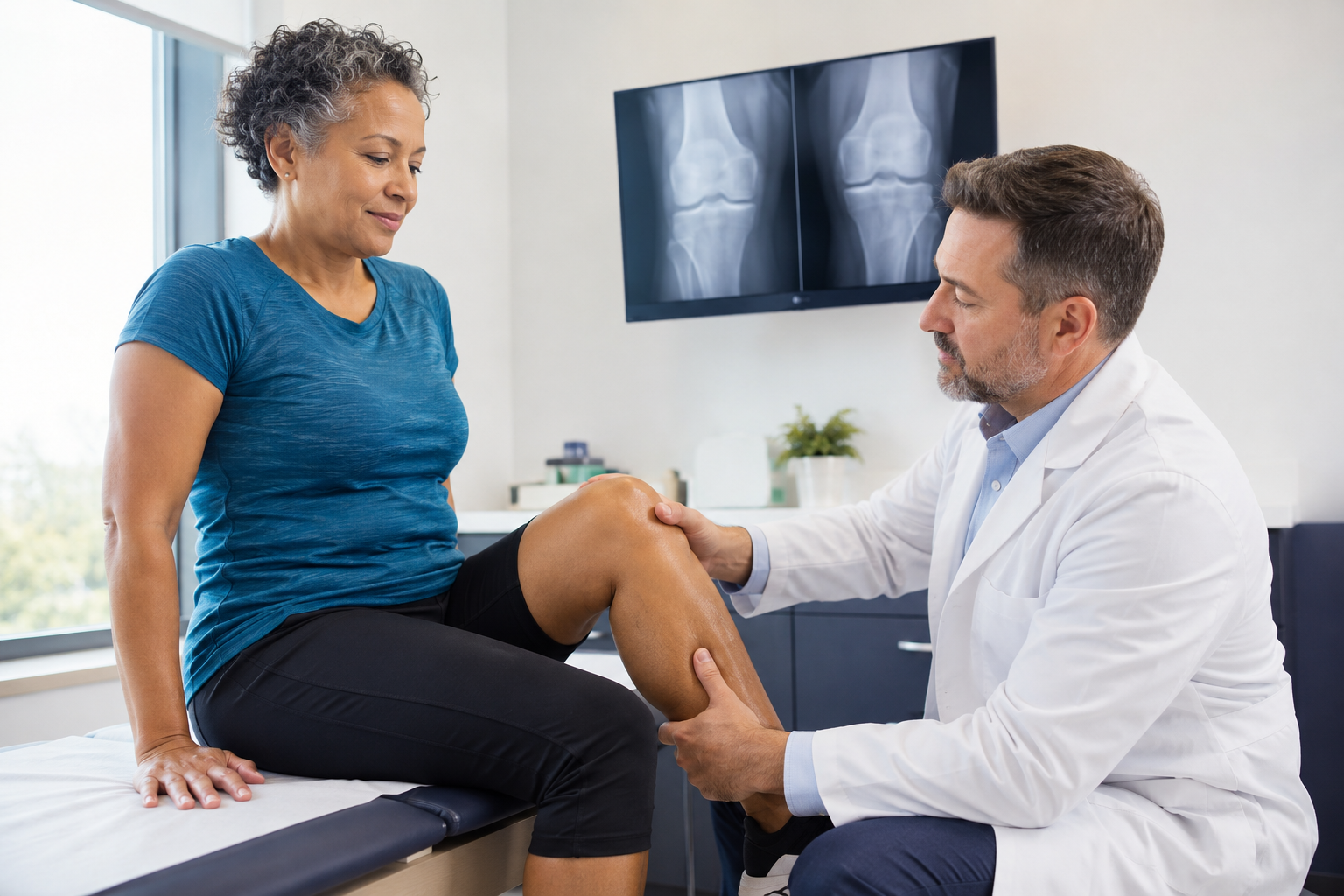
From there, imaging often confirms what’s happening beneath the surface. X-rays help with bone alignment and joint space narrowing, while an MRI shows soft tissue structures like the meniscus and cartilage more clearly.
That distinction matters because a meniscus tear and early-stage arthritis can look almost identical on the surface despite needing very different treatment.
Treatment Options for Knee Pain on Stairs in Reading, PA
Once the underlying cause is clear, treatment can be built around that specific diagnosis rather than a generic approach:
- Physical therapy to strengthen the quadriceps, hamstrings, and hip muscles, which takes pressure off the kneecap and improves how it tracks
- Bracing or taping to correct kneecap alignment during activity and reduce irritation
- Anti-inflammatory approaches, including activity modification and targeted icing, to calm swelling around the joint
- Corticosteroid or joint injections for more persistent inflammation that hasn’t responded to conservative measures
- Genicular nerve treatments for chronic pain that hasn’t improved with standard first-line care
- Minimally invasive procedures aimed at addressing the specific structure causing the pain whether that’s the tendon, cartilage, or joint lining rather than simply masking symptoms with medication
For patients seeking local care, MVM Health’s pain management specialists in Reading, PA can evaluate persistent knee pain and help develop a treatment plan based on the underlying cause.
Self-Care Tips While You Wait for Your Appointment
- Use the handrail, and lead with your stronger leg going up while leading with the sore leg coming down
- Apply ice for 15 to 20 minutes after activity to help reduce inflammation and swelling
- Avoid deep squats, kneeling, or high-impact activity until the cause is properly confirmed
- Keep moving gently rather than resting completely. Total inactivity can actually weaken the muscles that support your knee.
- Choose supportive, well-cushioned footwear over flat, worn, or unsupportive shoes
- Consider a knee sleeve or light compression wrap during activity for added stability while symptoms are active
Preventing Knee Pain on Stairs Long-Term
Most stair-related knee pain responds well to consistent quadriceps and hip strengthening, since stronger muscles absorb more of the load that would otherwise land directly on the joint itself. Stretching tight hamstrings, calves, and the IT band, maintaining a healthy body weight, and gradually building up activity levels rather than jumping straight into intense workouts after long periods of inactivity all reduce the repetitive strain that stairs place on the knee joint over time.
Simple daily habits also add up. Warming up before activity, alternating which leg leads on stairs when possible, and paying attention to early warning signs instead of pushing through pain can prevent a minor irritation from developing into a more persistent condition. This matters even more if you’ve previously had knee surgery, since stairs are often the first activity where lingering post-surgical pain resurfaces. See our guide on chronic pain after knee surgery if that sounds familiar.
Take the Next Step Toward Pain-Free Stairs
Don’t let knee pain keep dictating how you move through your day. MVM Health’s board-certified specialists can pinpoint exactly which condition is behind your pain and start you on a treatment plan built around it.
Schedule Your Appointment Today or call (610) 936-8214 to speak with our team. Video consultations are also available if you’d rather start from home.
Related Articles
The Non-Surgical Path to Recovery: Meniscus Tear
How to Choose the Best Knee Pain Doctor Near Me
Chronic Pain After Knee Surgery: Understanding the Causes