

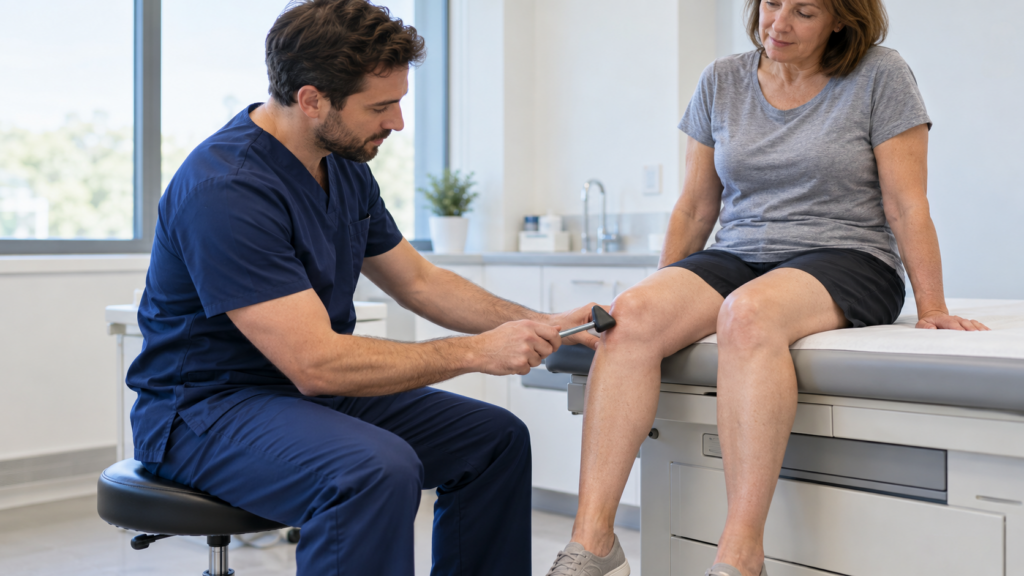
You finally have your MRI report, and it raises more questions than it answers. Maybe it describes a disc bulge on the left, but your pain runs down your right leg. Maybe it lists several “abnormal” levels, yet your symptoms feel limited to one spot. Or maybe the report looks almost normal while your leg still hurts. It’s one of the most common concerns we hear from patients exploring sciatica treatment in Bethlehem, PA.
This kind of mismatch is common, and it does not mean your pain is imagined or that the scan was wrong. For people seeking sciatica treatment in Bethlehem, PA, understanding how clinicians read MRI findings alongside your symptoms can make your next appointment more productive. This guide focuses on that one question: what happens when the picture and the pain don’t line up.
Why Don’t My MRI Findings Match My Sciatica Symptoms?
MRI findings may not match sciatica symptoms because an MRI shows structure, not pain. Many disc bulges and degenerative changes appear in people with no symptoms at all. An MRI is also a single snapshot, usually taken lying down, while nerve irritation can involve inflammation, movement, and posture that a still image may not capture. Clinicians therefore interpret MRI results alongside where your symptoms travel, your history, and a hands-on examination.
Sciatica Treatment in Bethlehem: Why MRI Findings and Symptoms Differ
Several ordinary reasons explain why MRI results and leg pain do not always point to the same place.
Many findings are common without pain. A large review in the American Journal of Neuroradiology found that disc degeneration appeared on imaging in about 37% of pain-free 20-year-olds and 96% of pain-free 80-year-olds (Brinjikji et al., 2015). The authors concluded that many of these changes are likely part of normal aging and should be read in the context of a person’s clinical condition. So a report listing several findings does not mean each one is causing symptoms.

A nerve can be irritated without being visibly squeezed. Sciatica-type pain can involve chemical inflammation around a nerve root, not just physical pressure. A small herniated disc near a sensitive nerve may cause more symptoms than a larger change elsewhere.
Position and timing matter. Most MRIs are taken lying still, which can take load off the spine. Symptoms that flare when you sit, stand, or walk may relate to changes, such as spinal stenosis, that look milder on a resting scan. A scan taken weeks after symptoms started may also show a disc that has already begun to shrink.
Pain can come from outside the lumbar spine. Leg pain that resembles sciatica can sometimes stem from the hip, the sacroiliac joint, the piriformis region, or nerves further down the leg. A lumbar MRI will not show those areas.
MRI Findings Vs. Sciatica Symptoms: Common Mismatches
These are typical patterns patients notice when comparing their report with how their leg feels, and what a clinician may look at next.
| What the MRI shows | What you feel | Possible explanations | What a clinician may check |
| Disc bulge on one side | Pain in the opposite leg | Bulge may be incidental; another level or a central change may be involved | Which nerve pattern your symptoms follow; exam on both sides |
| Changes at several levels | Pain in one specific area | Not every finding is active; one level may match your symptoms | Your symptom map compared level by level |
| Large herniation | Mild or improving symptoms | Size alone does not predict pain; discs can shrink over time | How symptoms have changed since onset |
| Mild or “normal” report | Significant leg pain | Inflammation, position-dependent changes, or a source outside the lumbar spine | Hip, sacroiliac, and nerve exam; how pain responds to movement |
| Finding at one level | Symptoms in a different nerve’s territory | Nerve anatomy varies; pain can be referred | Strength, reflex, and sensation testing |
This table is general education, not a diagnosis. Only a clinician who examines you can interpret your own report.
Does Your MRI Report Not Match Where Your Leg Hurts?
You don’t have to figure it out alone. At MVM Health in Bethlehem, our pain specialists review your MRI findings side by side with your symptom pattern, history, and a hands-on exam. Bring your report and questions, and leave with a clearer picture of what may be driving your sciatica.
How Clinicians Match the MRI to Your Symptoms
During a sciatica evaluation in Bethlehem, the MRI is one piece of evidence, not the final word. Clinicians look for agreement between three sources.
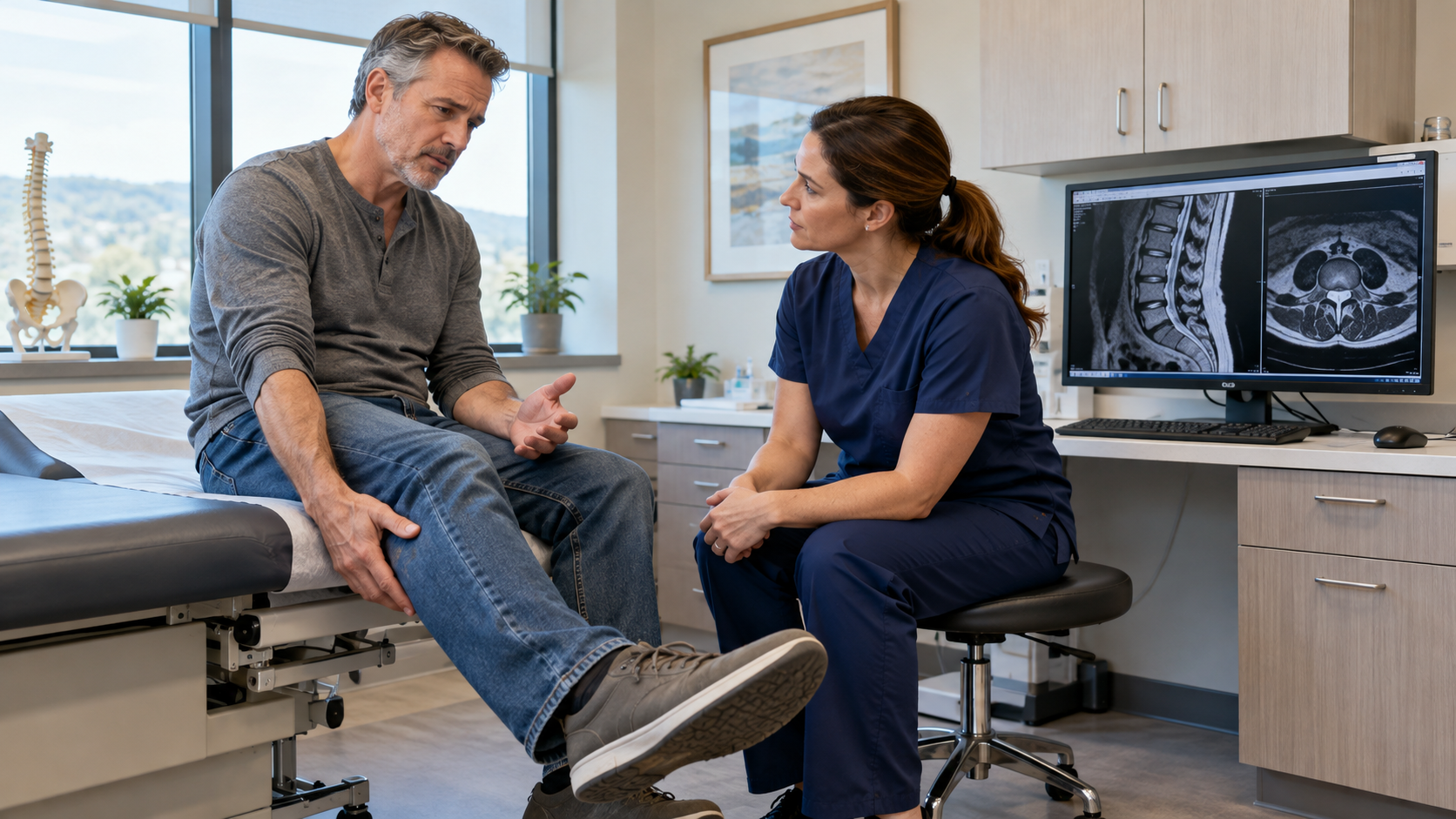
Where your symptoms travel. Each lower spinal nerve root tends to supply a recognizable strip of the leg and foot. Pain, numbness, or tingling along the outer calf points to a different nerve than symptoms along the front of the shin. Mapping your exact path helps identify which level, if any, on the MRI fits.
Your history. How symptoms began, what makes them better or worse, and how they have changed over time all add context. Pain that worsens with sitting tells a different story than pain that worsens with walking.
The physical examination. Strength, reflexes, sensation, and nerve tension tests can show which nerve is affected. Examining the hip and pelvis can help rule out sources the MRI does not cover.
When all three line up with a finding on the scan, that finding is more likely to be relevant. When they don’t, a clinician may weigh the exam more heavily or consider further testing, such as nerve conduction studies. You can read more about the condition itself on our sciatica treatment page.
What to Bring and Ask When Your MRI Doesn’t Match
A little preparation helps your clinician connect your report to your symptoms. Bring the full radiology report and, if possible, the image disc or portal access. A simple sketch of where your leg symptoms travel, and notes on what positions or activities change them, can also help.
Questions worth asking:
- Which finding on my MRI, if any, matches the path of my leg symptoms?
- Are any of these findings likely age-related or incidental?
- Does my exam point to the same nerve level as the scan?
- Could my symptoms be coming from somewhere the MRI didn’t image?
- Would any additional tests help clarify the mismatch?
If you have already read our [Bethlehem sciatica article] [LINK], this conversation goes one step further by focusing on your specific imaging. Patients across the Lehigh Valley can find directions and clinic details on our Bethlehem pain treatment page.