
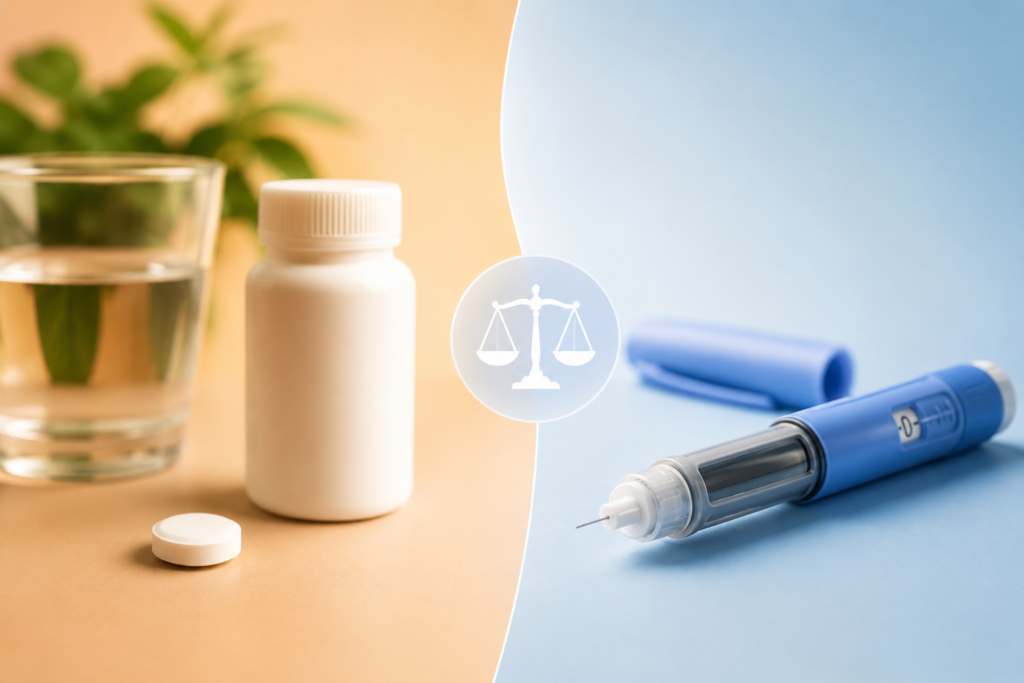
Oral semaglutide (Rybelsus, and now the Wegovy pill) and injectable semaglutide (Ozempic, Wegovy injection) contain the same active ingredient, but they’re absorbed very differently. Injectable semaglutide reaches the bloodstream almost completely, around 89% bioavailability, while the pill form has to survive stomach acid first, which significantly limits how much actually gets absorbed. In practice, this means injections generally produce greater weight loss, but the needle-free pill form has become a serious option for people who want to avoid injections, especially now that a higher-dose oral Wegovy has entered the market.
At MVM Health, this is one of the most common questions we get from patients starting GLP-1 treatment: pill or injection? The honest answer is that both are legitimate options, but they’re not interchangeable, and the right choice depends on your goals, your tolerance for injections, and how much weight loss you’re aiming for.
Key Takeaways
- Oral and injectable semaglutide share the same active ingredient but differ substantially in absorption, dosing frequency, and typical results
- Injectable semaglutide (Wegovy) has produced average weight loss around 15% of body weight in trials; standard-dose oral semaglutide (Rybelsus) has generally produced closer to 3–5% at approved doses
- A new higher-dose oral Wegovy pill, FDA-approved in December 2025, showed considerably stronger results in trials, closing some of that gap
- Rybelsus is taken daily on an empty stomach with strict timing rules; injections are taken once weekly with more flexibility
- Needle-free administration is the single biggest reason patients choose the pill form despite the historical efficacy trade-off
What’s the Actual Difference Between Oral and Injectable Semaglutide?
The core difference isn’t the drug itself, it’s how much of it your body actually absorbs. Both forms deliver semaglutide, a GLP-1 receptor agonist that reduces appetite and helps regulate blood sugar. But the route into your bloodstream changes everything about dosing, frequency, and typical results.
- Injectable semaglutide is injected under the skin and absorbed almost completely, giving it high bioavailability.
- Oral semaglutide has to survive the digestive tract before absorption, which destroys much of the dose before it ever reaches the bloodstream. This is why oral formulations require special formulation technology and strict dosing instructions just to achieve modest absorption.
Oral Semaglutide vs. Injection: Side-by-Side Comparison
| Feature | Oral Semaglutide (Rybelsus / Wegovy pill) | Injectable Semaglutide (Ozempic / Wegovy) |
| Administration | Daily pill, swallowed on an empty stomach | Once-weekly injection under the skin |
| Bioavailability | Low; much of the dose is broken down before absorption | High, around 89% |
| Typical weight loss (standard Rybelsus dose) | Roughly 3–5% of body weight | Roughly 15% of body weight (Wegovy 2.4mg) |
| Dosing flexibility | Must be taken first thing in the morning, on an empty stomach, with a small amount of water | Can be taken any day/time, with or without food |
| Refrigeration required | No | Yes (until first use, depending on product) |
| Needle involved | No | Yes |
| FDA-approved use | Rybelsus: type 2 diabetes. Wegovy pill: chronic weight management | Ozempic: type 2 diabetes. Wegovy: chronic weight management, and cardiovascular risk reduction |
Which Works Better for Weight Loss: The Pill or the Shot?
Historically, injectable semaglutide has produced meaningfully greater weight loss than standard-dose oral semaglutide, largely because of the bioavailability gap described above. In clinical trials, people taking Wegovy’s 2.4 mg weekly injection lost an average of close to 15% of their body weight over roughly 68 weeks. Standard-dose Rybelsus, by comparison, has generally produced results in the single digits, closer to 3–5% of body weight, depending on the specific dose and study.
That gap has started to close. A new, higher-dose oral formulation of Wegovy was FDA-approved in December 2025, following trial data showing meaningfully stronger weight loss than the original Rybelsus pill, though still generally trailing the injectable version’s top results. For patients specifically motivated to avoid needles, this newer oral option represents a real step forward compared to what oral GLP-1 treatment used to offer.
Why Does the Injection Work Better Than the Pill?
The short answer is bioavailability, the percentage of a drug that actually makes it into your bloodstream and becomes active. Injected semaglutide bypasses the digestive system entirely, so nearly all of the dose is available for your body to use. Swallowed semaglutide has to survive stomach acid and digestive enzymes, which break down most peptide-based drugs like semaglutide before they can be absorbed.
Oral semaglutide gets around this with a specific delivery technology and strict administration rules, but even with those workarounds, only a fraction of each dose reaches the bloodstream compared to an injection. This is also why oral semaglutide has such particular timing requirements, taking it with food or too soon after eating meaningfully reduces how much of the drug gets absorbed at all.
Dosing Differences You Should Know
Oral semaglutide (Rybelsus):
- Taken once daily, first thing in the morning
- Must be swallowed on an empty stomach with no more than 4 ounces of water
- You need to wait at least 30 minutes before eating, drinking anything else, or taking other oral medications
- Dosing typically starts at 3 mg for the first month, increasing to 7 mg, and sometimes up to 14 mg based on response
Injectable semaglutide (Ozempic/Wegovy):
- Injected once weekly, any day and time, with or without food
- Injection site should be rotated weekly (abdomen, thigh, or upper arm)
- Dosing starts low and is gradually increased every four weeks to reduce side effects
- The dosing day can be changed if needed, as long as it’s been at least two days since the last dose
The daily, empty-stomach requirement for the pill is often the biggest lifestyle adjustment for patients, more so than the pill itself.

Are Side Effects Different Between the Two Forms?
Both forms of semaglutide share a similar side effect profile, since it’s the same active ingredient. The most common side effects for either form include nausea, constipation, diarrhea, and reduced appetite, especially during dose increases.
Some patients report that the oral form causes more noticeable digestive symptoms initially, likely related to how the pill is absorbed directly in the gastrointestinal tract. Others find the injectable form easier to tolerate simply because dosing changes happen weekly rather than daily. Individual response varies enough that this isn’t a reliable way to predict which form will suit you better.
Which One Should You Choose?
There’s no universally “better” option. The right choice depends on a few practical factors:
- Needle aversion. If avoiding injections is a priority, the oral pill, especially the newer higher-dose Wegovy formulation, is a legitimate option worth discussing with your provider.
- Weight loss goals. If you’re aiming for the most significant possible weight loss and are comfortable with a weekly injection, the injectable form still generally produces stronger average results.
- Daily routine. The pill requires a consistent morning routine with strict timing. The injection requires remembering one dose per week, with more flexibility around timing.
- Insurance coverage. Coverage varies significantly by form, brand, and indication. It’s worth confirming with your insurer which specific medication and formulation your plan covers before deciding.
- Refrigeration and travel. The oral pill doesn’t require refrigeration, which some patients find more convenient for travel.
Not Sure Which Semaglutide Option Is Right for You?
Choosing between oral and injectable semaglutide depends on your weight loss goals, daily routine, treatment preferences, and medical needs. MVM Health can help you understand your options and choose an approach that fits your goals.
What We See With Patients
In practice, needle aversion is the single most common reason patients ask about the pill form, far more often than a preference based on the efficacy numbers alone. What we try to make clear during that conversation is the actual trade-off: for most patients focused purely on maximizing weight loss, the injection still tends to outperform the standard oral dose. The newer higher-dose oral Wegovy has narrowed that gap meaningfully, and for patients who would otherwise avoid treatment altogether because of needles, it’s changed the conversation. The right starting point really does depend on what matters most to the individual patient, not a one-size-fits-all recommendation.
Talk to a Provider Before Choosing
Both oral and injectable semaglutide are legitimate, FDA-approved paths to meaningful weight loss and metabolic improvement, but they’re not interchangeable, and the right one depends on your specific health history, goals, and preferences. At MVM Health, our medical weight loss team can walk you through both options and help you choose the one that actually fits your life. Schedule a consultation to find out which form makes sense for you.
Frequently Asked Questions
1. Is oral semaglutide as effective as the injection for weight loss?
Standard-dose oral semaglutide (Rybelsus) has generally produced less weight loss than injectable semaglutide in clinical trials, largely due to lower absorption. A newer, higher-dose oral Wegovy pill, approved in December 2025, has shown meaningfully stronger results, though it still generally trails the top injectable outcomes.
2. Why do I have to take Rybelsus on an empty stomach?
Oral semaglutide’s absorption drops significantly if it’s taken with food or too soon before eating. Taking it first thing in the morning with a small amount of water and waiting at least 30 minutes before eating helps maximize how much of the dose is actually absorbed.
3. Can I switch from the injection to the pill, or vice versa?
Yes, this is a conversation to have with your prescribing provider, since dosing isn’t directly interchangeable between the two forms. Your provider will typically start you on an appropriate dose for the new form rather than converting the dose directly.
4. Does the semaglutide pill require refrigeration like the injection?
No. Oral semaglutide doesn’t require refrigeration, which many patients find more convenient, particularly for travel. Injectable semaglutide typically requires refrigeration before first use.
5. Are the side effects different between oral and injectable semaglutide?
Both forms share a similar side effect profile, mainly nausea, constipation, and digestive changes, since they contain the same active ingredient. Some patients notice more digestive symptoms with the oral form, though individual response varies.
6. Is there a needle-free option with better weight loss results than Rybelsus?
Yes. A higher-dose oral Wegovy pill was FDA-approved in December 2025 and has shown stronger weight loss results than standard-dose Rybelsus in clinical trials, offering a needle-free option with improved efficacy compared to earlier oral semaglutide options.
7. Why is injectable semaglutide more effective than the pill?
Injections bypass the digestive system, so nearly all of the dose reaches the bloodstream. Oral semaglutide has to survive stomach acid and digestive enzymes first, which significantly reduces how much of each dose is actually absorbed.
8. Does insurance cover oral semaglutide the same way as injections?
Not necessarily. Coverage depends on your specific plan, the medication’s FDA-approved indication, and whether it’s prescribed for diabetes versus weight management. It’s worth confirming coverage details for the specific form and brand your provider recommends.
Medical Disclaimer
This article is intended for general educational purposes and does not constitute individual medical advice. Decisions about starting, switching, or combining GLP-1 medications should be made in consultation with a qualified healthcare provider based on your full medical history.