

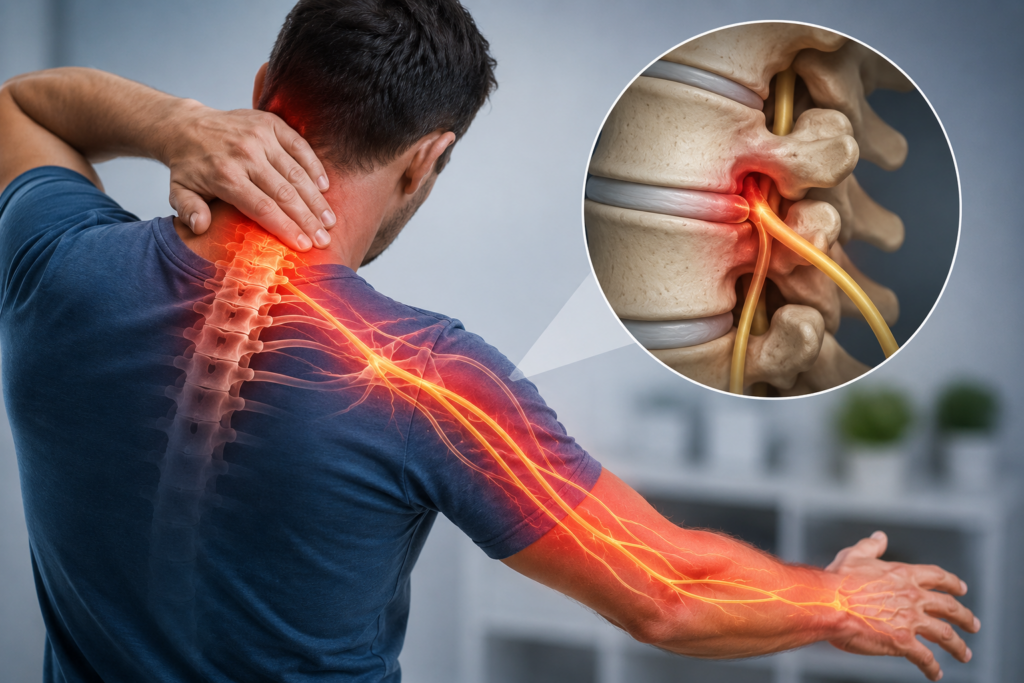
Shooting arm pain that travels from your neck or shoulder down into your hand is usually a nerve problem, not a muscle strain. Pinched nerves in the cervical spine are one possible and common cause, although other nerve, joint, and medical conditions can produce similar symptoms. If the pain feels sharp, electric, or comes with tingling and weakness in your fingers, that pattern points toward nerve involvement rather than a simple pulled muscle. This article walks through what causes that sensation, how to tell a pinched nerve apart from other causes, and when to seek an evaluation at the MVM Health clinic in Exton, PA.
Here’s the part most people don’t expect: the pain you feel in your bicep, forearm, or fingertips may have nothing to do with your arm at all. The actual problem could be sitting three inches from your collarbone, in a small nerve root exiting your cervical spine.
What Does Shooting Arm Pain Actually Feel Like?
Shooting arm pain is usually described as a sudden, electric-shock sensation that runs along a specific path, rather than a dull, generalized ache. People dealing with this often describe it as:
- A jolt that starts near the neck or shoulder blade and travels down to the elbow or hand
- A burning or “pins and needles” feeling in specific fingers
- Pain that worsens when turning the head, reaching overhead, or lying flat
- Occasional weakness when gripping objects like a coffee mug or steering wheel
- A feeling that certain fingers are “asleep” for longer than a minute or two
This pattern is different from a muscle strain, which tends to stay localized, feel achy or tight, and improve with rest within a few days. When the pain radiates and follows a clear line down the arm, a nerve is almost always involved somewhere along that path. The direction and intensity of the radiation can actually help pinpoint the source, which is why paying attention to exactly where the pain travels matters more than most people realize.
Could It Be a Pinched Nerve? Understanding Cervical Radiculopathy
A pinched nerve in the neck, medically known as cervical radiculopathy, happens when a nerve root in the cervical spine becomes compressed or irritated as it exits between the vertebrae. According to research published by the National Institutes of Health, this condition typically produces arm pain that follows the specific path of the affected nerve root and gets worse when the head tilts toward the painful side.
The nerves branching out from your cervical spine control sensation and movement in your shoulder, arm, and hand. When one of these nerve roots gets squeezed by a herniated disc, a bone spur, or general wear-and-tear changes, the signal disruption shows up as shooting arm pain, not neck pain alone. That’s why many people are confused when their neck barely hurts, yet their arm feels like it’s on fire.
Each cervical nerve root serves a specific region of the arm and hand, which is why the exact location of your symptoms carries diagnostic value. Pain and numbness reaching the thumb and index finger often point to a different nerve level than symptoms concentrated in the ring and pinky fingers. This mapping, known as a dermatomal pattern, is one of the first things a physician checks during a physical exam.
Common Causes Behind a Pinched Nerve
Several structural changes in the cervical spine can lead to nerve compression:
- Herniated or bulging disc: The soft inner material of a spinal disc pushes outward and presses against a nearby nerve root
- Bone spurs (osteophytes): Age-related arthritis can cause small bony growths that narrow the space where nerves exit the spine
- Foraminal narrowing: The opening (foramen) where the nerve root passes through gradually tightens due to degeneration
- Poor posture and repetitive strain: Prolonged forward head posture, common with desk work and phone use, adds sustained pressure on the cervical spine over time
- Trauma or sudden injury: A fall, whiplash, or awkward lifting motion can trigger acute compression
Who Is More Likely to Develop a Pinched Nerve
A pinched nerve doesn’t affect everyone equally. Certain factors raise the likelihood of developing cervical radiculopathy:
- Age: Disc-related nerve compression tends to affect adults under 50, while degenerative changes and bone spurs are more common in people in their 50s and 60s
- Occupation: Jobs involving repetitive overhead movement, prolonged screen time, or heavy lifting place extra strain on the cervical spine
- Previous neck injury: A history of whiplash or spinal trauma increases the odds of future nerve irritation
- Smoking: Reduced blood flow to spinal discs can accelerate degeneration
- Sedentary habits combined with poor posture: Weak neck and upper back muscles offer less support to the cervical spine
Other Reasons Behind Shooting Arm Pain (It’s Not Always the Neck)
Not every case of radiating arm pain originates in the cervical spine. Several other conditions can mimic a pinched nerve, which is exactly why a proper evaluation matters before assuming the cause.
- Thoracic outlet syndrome: Compression of nerves or blood vessels between the collarbone and first rib, often causing numbness in the hand along with arm heaviness
- Cubital tunnel syndrome: Compression of the ulnar nerve at the elbow, typically affecting the ring and pinky fingers
- Rotator cuff injury: Shoulder tendon damage that can radiate pain down the upper arm, though it rarely causes the same electric quality as a nerve issue
- Peripheral nerve entrapment: Compression occurring further down the arm, such as at the wrist (carpal tunnel syndrome)
- Referred cardiac pain: In rare but serious cases, left arm pain accompanied by chest pressure, shortness of breath, or sweating can signal a heart-related emergency and needs immediate attention
This is precisely why self-diagnosing based on symptoms alone can be misleading. Two very different conditions can produce a strikingly similar sensation in the arm, and treating the wrong one delays actual relief.
Pinched Nerve vs. Other Common Causes: A Quick Comparison
| Feature | Pinched Nerve (Cervical Radiculopathy) | Rotator Cuff Injury | Thoracic Outlet Syndrome | Cubital Tunnel Syndrome |
| Typical pain quality | Sharp, electric, shooting | Dull, aching, worse with overhead motion | Heaviness, aching, numbness | Tingling in ring/pinky fingers |
| Where it starts | Neck or shoulder blade | Shoulder joint | Collarbone/upper chest area | Inner elbow |
| Worsens with | Neck movement, tilting head | Lifting arm overhead | Carrying bags, overhead reaching | Bending elbow, leaning on it |
| Numbness pattern | Follows a specific nerve root (dermatome) | Rarely present | Whole hand, especially at rest | Ring and pinky fingers only |
| Common age group | Under 50 (disc-related) or 50s-60s (degenerative) | Any age, common in overhead athletes | 20s-40s, often repetitive strain | Any age, common with prolonged elbow flexion |
When Should You See a Specialist?
Not every twinge in the arm requires an immediate visit, but certain signs should not be ignored. Consider scheduling an evaluation if you notice:
- Shooting arm pain that persists beyond one to two weeks despite rest
- Numbness or tingling that doesn’t improve or keeps spreading
- Noticeable weakness when gripping, lifting, or holding objects
- Pain that disrupts sleep or worsens at night
- Symptoms that began after a fall, accident, or sudden neck movement
Seek care sooner, even same-day, if arm pain is paired with chest tightness, difficulty breathing, or sweating, since these combined symptoms may point to a cardiac issue rather than a spinal one.
Waiting too long often allows a manageable nerve irritation to progress into something requiring more involved treatment. Early evaluation may help identify the cause sooner and allow treatment options to be considered before symptoms become more limiting.
How MVM Health Diagnoses the Source of Arm Pain
Getting an accurate diagnosis starts with separating a true pinched nerve from the other conditions that can mimic it. At MVM Health, this typically includes:
- Detailed symptom history: Understanding where the pain starts, how it travels, and what movements make it better or worse
- Physical examination: Testing reflexes, strength, and sensation along specific nerve pathways
- Provocative maneuvers: Positioning the neck in ways that reproduce or relieve symptoms, which helps confirm nerve involvement
- Imaging when needed: X-rays to check alignment and bone spurs, or MRI when a herniated disc or nerve compression is suspected
A scan alone doesn’t tell the full story. Many adults show age-related changes on imaging without ever feeling pain, so the diagnosis has to match the symptoms and physical findings, not just what a report says. You can read more about how our team approaches chronic pain conditions and diagnosis across different sources of nerve and joint pain.

What to Expect During Your First Visit
Walking into a first appointment for arm pain can feel uncertain, especially if you’re unsure whether it’s a neck issue or something else. A typical first visit usually follows this order:
- A conversation about when the pain started, what makes it better or worse, and any prior injuries
- A hands-on physical exam checking strength, reflexes, and sensation in specific fingers
- A discussion of possible causes based on exam findings, before any imaging is ordered
- A plan for next steps, whether that’s starting conservative treatment right away or scheduling imaging first
Patients from Exton and surrounding Chester County communities are often relieved to learn that most pinched nerve cases don’t require surgery as a first step. The initial focus is almost always on reducing pressure on the nerve through less invasive means.
Treatment Options for a Pinched Nerve
Once a pinched nerve is confirmed as the cause, treatment is built around reducing pressure on the affected nerve root and calming inflammation. Options generally include:
- Physical therapy: Targeted exercises that open up space around the compressed nerve and improve posture
- Anti-inflammatory medication: Reducing swelling around the irritated nerve root
- Cervical epidural steroid injections: Delivering medication directly to the inflamed nerve for more targeted relief
- Activity and posture modification: Adjusting desk setup, sleep position, or repetitive movements that aggravate the nerve
- Minimally invasive interventional procedures: For persistent cases, image-guided techniques can target the exact nerve involved
Most patients respond well to non-surgical approaches, and surgery is generally reserved for cases where conservative treatment hasn’t provided relief after several weeks, or when there is significant weakness. MVM Health’s interventional pain care approach focuses on identifying the precise source before recommending a treatment path, so patients aren’t guessing at what might help.
Recovery Timeline and What Influences It
Recovery from a pinched nerve varies based on the underlying cause and how early treatment begins. In general:
- Mild nerve irritation from posture or minor strain often improves within two to six weeks with conservative care
- Herniated disc-related compression may take six to twelve weeks to settle with physical therapy and activity changes
- Cases involving significant bone spurs or long-standing degeneration may need a longer, staged treatment approach
- Consistency with posture correction and prescribed exercises tends to shorten recovery time, while ignoring symptoms often extends it
If you’ve already dealt with related spinal discomfort, our guide on lower back pain in Exton covers a similar diagnostic approach for nerve-related pain lower in the spine, which shares many of the same underlying mechanics as cervical radiculopathy.
Everyday Habits That Can Reduce Pressure on Cervical Nerves
While not every case of nerve compression can be prevented, several daily habits reduce the load placed on the cervical spine and may lower the chance of recurring arm pain:
- Keeping screens at eye level to avoid prolonged forward head posture
- Taking short movement breaks every 30 to 45 minutes during desk work
- Sleeping with a pillow that supports the natural curve of the neck
- Strengthening the muscles supporting the neck and upper back
- Avoiding sudden, forceful neck movements during exercise or lifting
Getting Evaluated in Exton
Shooting arm pain that persists or comes with numbness or weakness may need proper evaluation. MVM Health’s Exton team can identify the cause and recommend the right treatment.