
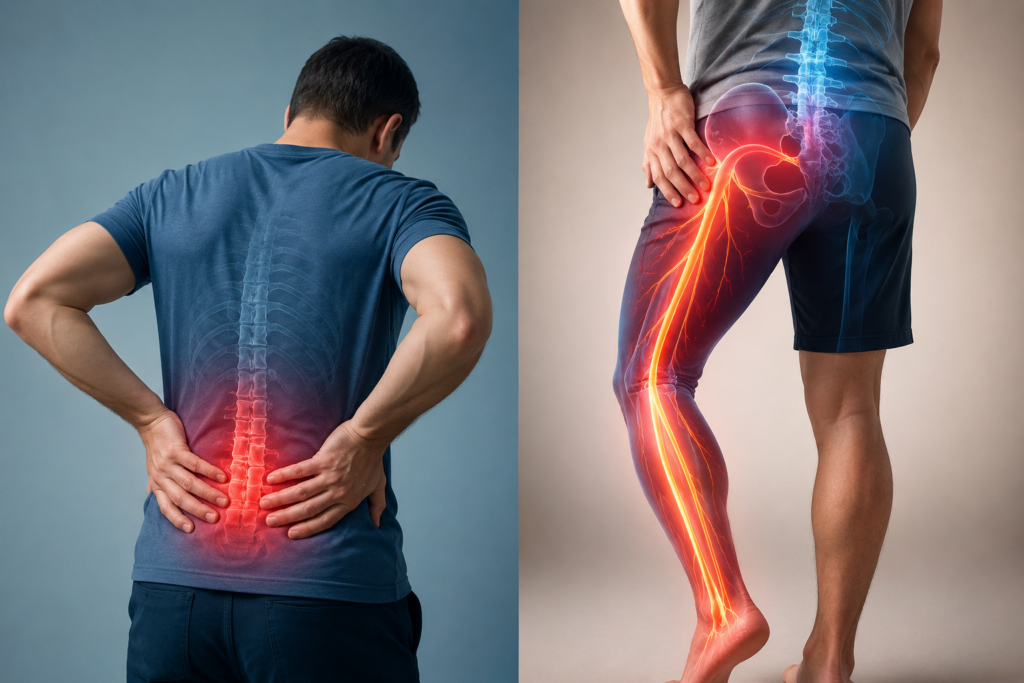
If your lower back hurts and you’re not sure whether it’s just muscle strain or something pressing on a nerve, here’s the quick answer: sciatica vs back pain comes down to where you feel it. Regular back pain stays in your lower back. Sciatica travels, radiating from your lower back through your hip and down one leg, often with numbness or a burning, electric-shock feeling. That single distinction, whether the pain stays put or moves down your leg, is usually enough to point you in the right direction before you even see a doctor.
Patients at MVM Health locations in Bethlehem, Reading, King of Prussia, and across Pennsylvania ask about sciatica vs back pain almost every week. Both conditions can be miserable. Both can be caused by similar things, like a herniated disc or years of wear on the spine. But they don’t always respond to the same treatment, which is exactly why getting the distinction right matters before you start icing the wrong spot or stretching a nerve that needed rest instead.
What Is Back Pain?
Back pain, sometimes called mechanical or axial back pain, is discomfort that stays centered in the spine or the muscles and ligaments around it. It doesn’t typically travel down your leg. It doesn’t usually come with numbness or tingling in your foot, which is one of the clearest markers when comparing back pain vs sciatica symptoms.
Most adults will deal with it at some point. It’s one of the most common reasons people miss work or cut back on physical activity, and it ranges from a dull, nagging ache to a sharp pain that catches you off guard when you bend or twist. Back pain also falls into two broad categories worth knowing:
- Acute back pain, which comes on suddenly, usually after lifting, twisting, or an awkward movement, and often improves within a few days to a few weeks.
- Chronic back pain, which lasts longer than three months and is more often tied to ongoing issues like arthritis, disc degeneration, or repeated strain from posture and daily habits.
Typical features of ordinary back pain:
- Stays localized to the lower back, sometimes spreading slightly into the buttocks
- Often triggered or worsened by lifting, twisting, or prolonged sitting or standing
- Tends to ease with rest, movement modification, or over-the-counter anti-inflammatories
- Rarely involves numbness, tingling, or leg weakness
- Muscles around the lower back may feel tight, tender, or spasm-prone after activity
It’s the kind of pain your body usually announces after you’ve done something physical: shoveled snow, moved furniture, or sat hunched at a desk for six hours straight. It can also build up gradually from years of poor posture or carrying extra weight around the midsection, which puts steady strain on the lower spine.
What Is Sciatica?
Sciatica isn’t a condition on its own. It’s a set of symptoms caused by irritation or compression of the sciatic nerve, the longest and widest nerve in the body, formed by nerve roots that exit the lower spine (commonly L4 through S1) and combine into a single nerve that runs through the hips, buttocks, and down the back of each leg.
When something presses on one of those nerve roots (a bulging disc, a bone spur, or a tightened piriformis muscle in the buttock), the pain doesn’t stay in your back. It shoots down your leg, sometimes all the way to your foot or toes. According to Mayo Clinic’s overview of sciatica symptoms and causes, sciatica most often results from a herniated disk or an overgrowth of bone that puts pressure on part of the nerve, causing inflammation and pain that can range from a mild ache to a sharp, burning sensation.
Typical features of sciatica:
- Radiates from the lower back into the buttock and down one leg, sometimes reaching the foot
- Usually affects one side of the body only
- Often paired with numbness, tingling, or a “pins and needles” feeling
- Can flare up with sneezing, coughing, or sitting for long periods
- May feel like a dull ache one day and a sharp, electric jolt the next
A detail many patients don’t expect: sciatica pain often gets worse with sitting and eases somewhat with walking, which is the opposite pattern of how most muscle-related back pain behaves. This is exactly the kind of behavior pattern that helps separate sciatica vs back pain without needing imaging right away.
Sciatica vs. Back Pain: Key Differences
The easiest way to approach sciatica vs back pain is to ask yourself one question: does the pain stay in your back, or does it travel? That single answer tells you most of what you need to know.
Here’s a side-by-side breakdown that makes the comparison clearer:
| Feature | Sciatica | Back Pain |
| Pain Location | Lower back to leg | Back only or localized |
| Pain Type | Sharp, shooting | Dull, aching, or sharp |
| Numbness | Common | Rare |
| Leg Pain | Yes | Usually No |
| Common Cause | Sciatic nerve compression | Muscle strain, arthritis, disc issues |
Beyond the table, there are a few other clues worth paying attention to:
- Response to sitting versus standing. Sciatica often worsens the longer you sit, while ordinary back pain may feel steadier regardless of position, or worsen with standing for long stretches.
- One-sided versus centered pain. Sciatica is almost always one-sided. Mechanical back pain is more often centered or spread evenly across the lower back.
- Sensory changes. Numbness, tingling, or a “sleeping leg” feeling points toward nerve involvement rather than a muscle strain.
- Onset pattern. Back pain frequently follows a specific incident, like lifting something heavy. Sciatica can build gradually as a disc slowly bulges or as spinal narrowing progresses with age.
Symptoms Comparison
Since both conditions can start in the same general area, a proper sciatica vs back pain symptoms comparison depends more on timing and quality of pain than location alone.
Back pain symptoms typically include:
- A dull ache or stiffness in the lower back
- Muscle spasms after activity or sudden movement
- Pain that worsens with movement and improves with rest
- Tenderness when pressing on the lower back muscles
- Reduced flexibility when bending forward or twisting
Sciatica symptoms typically include:
A sharp, burning, or electric pain that shoots down one leg
Numbness or a tingling sensation in the thigh, calf, or foot
Weakness in the leg or foot in more advanced cases
Pain that worsens when sitting, sneezing, or coughing
A sensation described by patients as a jolt, similar to an electric shock
One detail patients often miss: sciatica doesn’t always come with noticeable back pain. Some people feel almost nothing in their lower back and instead notice the ache mostly in their leg, which throws off self-diagnosis more than people expect. This is one reason self-treating based on symptoms alone can delay the right care, and why comparing sciatica vs back pain properly requires a real exam rather than guesswork.
Causes of Each Condition
Back pain and sciatica sometimes share root causes, but the mechanism behind each is different, which is another angle worth considering in the sciatica vs back pain conversation.
Common causes of back pain:
- Muscle or ligament strain from lifting or sudden movement
- Poor posture sustained over long periods, especially at a desk
- Degenerative disc disease or facet joint arthritis
- Obesity or lack of core support around the spine
- Direct injury or trauma, such as a fall or car accident
Common causes of sciatica:
- Herniated or bulging disc pressing on a nerve root
- Spinal stenosis, a narrowing of the spinal canal that puts pressure on nerves
- Piriformis syndrome, where a small buttock muscle compresses the nerve
- Spondylolisthesis, where one vertebra slips forward over the one beneath it
- Bone spurs that develop from age-related wear on the spine
It’s also common for both to happen together. A herniated disc, for example, can cause localized back pain at the point of injury while also compressing the sciatic nerve and triggering leg symptoms at the same time. That overlap is part of why an accurate diagnosis matters instead of guessing based on symptoms alone. A thorough exam helps separate the two components so each can be addressed with the right approach, rather than treating both as the same problem.
How Doctors Diagnose the Problem
Diagnosis usually starts with a conversation. A physician will ask when the pain started, what makes it better or worse, and whether it radiates anywhere. From there, a physical exam typically includes:
- Straight leg raise test, where lifting the leg while lying down reproduces sciatic pain if the nerve is involved
- Reflex and strength testing, to check for nerve involvement in the leg or foot
- Range of motion assessment, to see how the spine moves and where it’s restricted
- Sensory testing, to map out where numbness or tingling occurs along the leg

If symptoms persist or point toward nerve involvement, imaging often follows. X-rays can rule out bone-related issues like fractures or alignment problems, while an MRI is the preferred method when a herniated disc or nerve compression is suspected, since it shows soft tissue detail that X-rays can’t capture. In select cases, a nerve conduction study (EMG) may be used to measure how well electrical signals travel along the sciatic nerve, which helps confirm the location and severity of compression.
At MVM Health locations across Pennsylvania, this diagnostic process is built around identifying the exact source of pain before recommending pain and spine treatment, rather than treating symptoms in isolation. A precise diagnosis can help guide a more targeted treatment plan and may improve the chances of addressing the underlying cause of symptoms.
Treatment Options for Sciatica vs. Back Pain
Treatment for sciatica vs back pain overlaps in the early stages but tends to diverge as symptoms persist.
For back pain, common approaches include:
- Rest paired with gentle movement, since total inactivity tends to slow recovery
- Heat or ice therapy to manage inflammation and muscle tension
- Physical therapy to strengthen supporting muscles and improve flexibility
- Over-the-counter anti-inflammatory medication
- Posture correction and ergonomic adjustments at work or home
For sciatica, common approaches include:
- Physical therapy focused on nerve mobility and core stability
- Epidural steroid injections to reduce inflammation around the compressed nerve
- Minimally invasive procedures targeting the specific point of compression
- Activity modification to avoid positions that aggravate the nerve
- In persistent or severe cases, surgical decompression to relieve pressure on the nerve root
Neither condition automatically requires surgery, and in certain patient populations, conservative treatment resolves symptoms within a matter of weeks. What separates a good outcome from a frustrating one is usually how early the underlying cause gets identified. Chasing generic stretches for months without addressing a compressed nerve, for instance, tends to prolong the problem rather than solve it. Patients exploring available pain conditions and treatment options often find that a targeted plan works faster than trial-and-error home care.
When to See a Pain Specialist
Most mild back pain resolves within a few weeks with basic self-care. Sciatica can also improve on its own, but there are signs that mean it’s time to stop waiting and get evaluated:
Find Out What’s Causing Your Back or Leg Pain
Whether your pain stays in your lower back or travels down your leg, getting the right diagnosis is the first step toward effective treatment. MVM Health’s pain and spine specialists evaluate symptoms like sciatica, nerve pain, and chronic back pain to create a personalized treatment plan based on your condition.
- Pain that lasts longer than two to three weeks despite rest and home care
- Numbness, tingling, or weakness that’s getting worse instead of better
- Pain severe enough to interrupt sleep or daily function
- Loss of bladder or bowel control, which warrants immediate medical attention
- Leg weakness that makes walking or standing difficult
- Pain following a fall, accident, or direct injury to the back
If any of these apply, waiting it out usually isn’t the right move. A pain specialist can pinpoint whether you’re dealing with mechanical back pain, true sciatica, or both, and build a plan around the actual cause instead of the surface symptom. Patients across East Stroudsburg, Bethlehem, King of Prussia, Reading, Lancaster, and Exton have access to that kind of evaluation without needing to travel far from home, and follow-up visits help track whether a treatment plan is actually working before symptoms have a chance to become chronic.
If your pain has been sticking around longer than it should, or if it’s started traveling down your leg instead of staying put, it’s worth getting a clear answer rather than guessing. Whether you’re near our Bethlehem, Reading, Lancaster, or King of Prussia office, MVM Health’s pain and spine team can evaluate what’s actually causing your pain, from imaging through a personalized treatment plan. Schedule a consultation today and get a diagnosis you can act on instead of another round of guesswork.