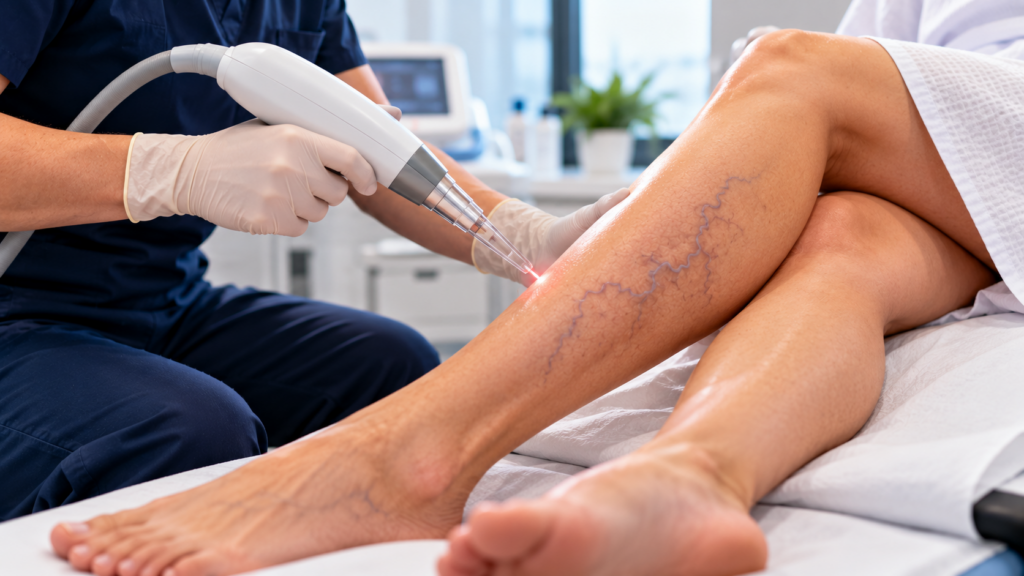


Restless legs syndrome (RLS) and vein disease can look nearly identical on the surface; both cause an uncomfortable, hard-to-ignore sensation in the legs that gets worse at rest and improves with movement. The key difference is the cause. RLS is classified as a neurological condition, while vein disease, specifically chronic venous insufficiency, is a circulation problem. Research increasingly shows the two overlap far more than most people realize, and in many cases, what looks like RLS is actually being driven by an underlying vein problem.
At MVM Health, we regularly see patients who’ve been managing “restless legs” for years with medication, only to find during a vein evaluation that treating an underlying venous reflux issue resolves symptoms that neurological treatment never fully addressed.
Key Takeaway
RLS and vein disease share overlapping symptoms: an urge to move the legs, discomfort that worsens at night, and relief with movement, which makes them easy to confuse. Studies have found that a large share of RLS patients also have chronic venous insufficiency, and treating the underlying vein problem often improves or resolves RLS symptoms. If your leg discomfort has a visible vein component, or if movement only helps temporarily, a vein evaluation is worth pursuing alongside any neurological workup.
What Is Restless Legs Syndrome?
Restless legs syndrome, also known as Willis-Ekbom disease, is a neurological condition marked by an uncontrollable urge to move the legs, usually paired with an uncomfortable sensation described as crawling, tingling, throbbing, or pulling. Symptoms typically follow a circadian pattern, meaning they’re worse in the evening and at night, and ease temporarily with movement.

RLS has traditionally been linked to causes like iron deficiency, kidney disease, pregnancy, and dopamine-related nerve activity in the brain. Medication is the standard first-line treatment when RLS is diagnosed as a primarily neurological issue.
What Is Vein Disease (Chronic Venous Insufficiency)?
Chronic venous insufficiency happens when the one-way valves inside leg veins weaken or fail, allowing blood to flow backward and pool in the lower leg instead of returning efficiently to the heart. This pooling raises pressure inside the vein, which can cause aching, heaviness, swelling, and, notably, the same kind of restless, uncomfortable sensations often attributed to RLS.
Varicose veins are the most visible sign of venous insufficiency, but the discomfort itself often shows up before any veins are visibly bulging.
The Research Connection Between RLS and Vein Disease
This isn’t a fringe theory. It’s a documented, growing area of vascular research.
- An early study published in Dermatologic Surgery screened over 1,300 patients for RLS and venous insufficiency and found a strong association between the two conditions.
- A 2007 case-control study by McDonagh and colleagues found RLS present in 36% of patients with chronic venous disorders, compared to 19% in a control group without vein disease, a statistically significant difference.
- A 2023 study led by Pyne and colleagues examined varicose veins, RLS, and nocturnal leg cramps across 506 individuals and found the association present in over 40% of that group.
- A systematic review covering studies through January 2024 found that 7 of 10 included studies reported a positive relationship between RLS and chronic venous insufficiency, with several showing meaningful symptom improvement after venous treatment such as ablation or sclerotherapy.
The proposed explanation is fairly straightforward. When blood pools in the leg due to failed valves, pressure builds inside the vein, which appears to irritate nearby nerve endings. That irritation may trigger the same urge-to-move sensation that defines RLS, even though the root cause is vascular rather than neurological.
Restless Legs vs. Vein Disease: Key Differences to Look For
Both conditions can feel remarkably similar in the moment, but a few patterns tend to separate them.
| Feature | More Likely RLS | More Likely Vein Disease |
| Visible veins | None | Bulging, twisted, or spider veins often present |
| Swelling | Uncommon | Common, especially by evening |
| Relief with elevation | Not typically helpful | Often provides noticeable relief |
| Relief with movement | Temporary, symptoms often return once still again | Movement helps, but compression or elevation also help significantly |
| Skin changes | None | Discoloration or texture changes near the ankle in advanced cases |
| Family history | Sometimes present | Strong genetic link, especially with visible varicose veins |
| Response to iron correction | May improve if iron deficient | No effect, since iron isn’t the underlying cause |
If your symptoms come with visible veins, ankle swelling, or noticeable relief when you elevate your legs, that pattern leans toward a venous cause rather than a purely neurological one.
Can You Have Both RLS and Vein Disease at the Same Time?
Yes, and based on the research, this may actually be the more common scenario rather than the exception. Given how frequently the two conditions overlap in study populations, many patients are dealing with true RLS that’s being aggravated by an underlying vein problem, rather than one condition existing in isolation.
Find Out If Your Restless Legs Could Be Linked to a Vein Problem
Persistent leg discomfort, nighttime restlessness, swelling, or heaviness may be signs of an underlying vein condition. A proper vein evaluation with duplex ultrasound can help identify whether venous insufficiency is contributing to your symptoms. At MVM Health, our vein specialists provide personalized evaluations and minimally invasive treatment options to help improve circulation and leg comfort.
This is exactly why an accurate diagnosis matters. Treating only the neurological side with medication may reduce symptoms somewhat, without ever addressing the venous component that’s contributing to them.
What We See in Practice
We’ve had more than one patient describe years of trying RLS medications with only partial relief, then mention almost in passing that their legs also ached or swelled by evening. That combination is a strong signal worth investigating. In several of these cases, a duplex ultrasound revealed clear venous reflux, and once that vein was treated, patients reported their restless leg symptoms improved substantially, sometimes enough to reduce or eliminate their need for RLS medication entirely, always in coordination with their prescribing physician.
This mirrors what’s shown up consistently in published research: patients with both conditions who receive vein treatment, whether sclerotherapy, endovenous ablation, or radiofrequency ablation, frequently see meaningful RLS symptom relief. It doesn’t mean vein treatment is a guaranteed cure for RLS, but it’s a connection too well-documented to overlook if you have signs of both.
How to Find Out Which Condition You Have
The only reliable way to tell the two apart, or confirm you have both, is through proper evaluation rather than trial and error with medication.
- Start with your primary care doctor or a neurologist if RLS is suspected, to rule out iron deficiency, kidney issues, or medication side effects.
- Get a vein evaluation if you have any visible veins, swelling, or aching, even if you’ve already been diagnosed with RLS.
- Ask specifically about a duplex ultrasound. This painless imaging test checks how blood is flowing through your leg veins and identifies any reflux that a physical exam alone might miss.
- Don’t assume one diagnosis rules out the other. Given how often these conditions overlap, it’s worth investigating both rather than stopping at the first explanation that fits.
Learn More About the RLS-Vein Connection
For a deeper look at how venous insufficiency specifically presents as restless leg symptoms and what treatment involves, visit our dedicated page on restless leg syndrome as a vein condition. It covers the diagnostic process and treatment path in more detail than we can here.
Treatment Options When Vein Disease Is the Cause
If a vein evaluation confirms venous insufficiency is contributing to your symptoms, treatment typically follows the same minimally invasive approach used for other vein conditions:
- Endovenous ablation. Heat energy (laser or radiofrequency) closes off the malfunctioning vein, redirecting blood through healthier veins nearby.
- Sclerotherapy. A solution is injected into smaller problem veins, causing them to collapse and fade.
- Compression therapy. Often used as an early step or alongside other treatments to support circulation.
- Medical adhesive closure. A minimally invasive option that seals the vein shut without heat.
You can see the full range of options we offer on our vein treatments page. Most procedures are done in-office, take under an hour, and involve little to no downtime.
Finding a Restless Leg Syndrome Vein Doctor Near You
If you’ve been managing RLS symptoms without full relief, and especially if you also notice visible veins, swelling, or aching, searching for a restless leg syndrome vein doctor near me is a reasonable next step. A vein specialist can run a duplex ultrasound to check for venous reflux, something a general RLS workup typically doesn’t include, and determine whether treating an underlying vein problem could meaningfully improve your symptoms.
Don’t Settle for Partial Relief
If you’ve been told you have restless legs syndrome but medication hasn’t fully resolved your symptoms, it’s worth asking whether an underlying vein problem could be part of the picture. The research connection between RLS and chronic venous insufficiency is well-documented, and for many patients, addressing the vein issue provides relief that neurological treatment alone couldn’t.
At MVM Health, our vein specialists can evaluate whether venous insufficiency is contributing to your restless leg symptoms and walk you through treatment options if it is. Schedule a consultation to find out what’s really behind your symptoms.