
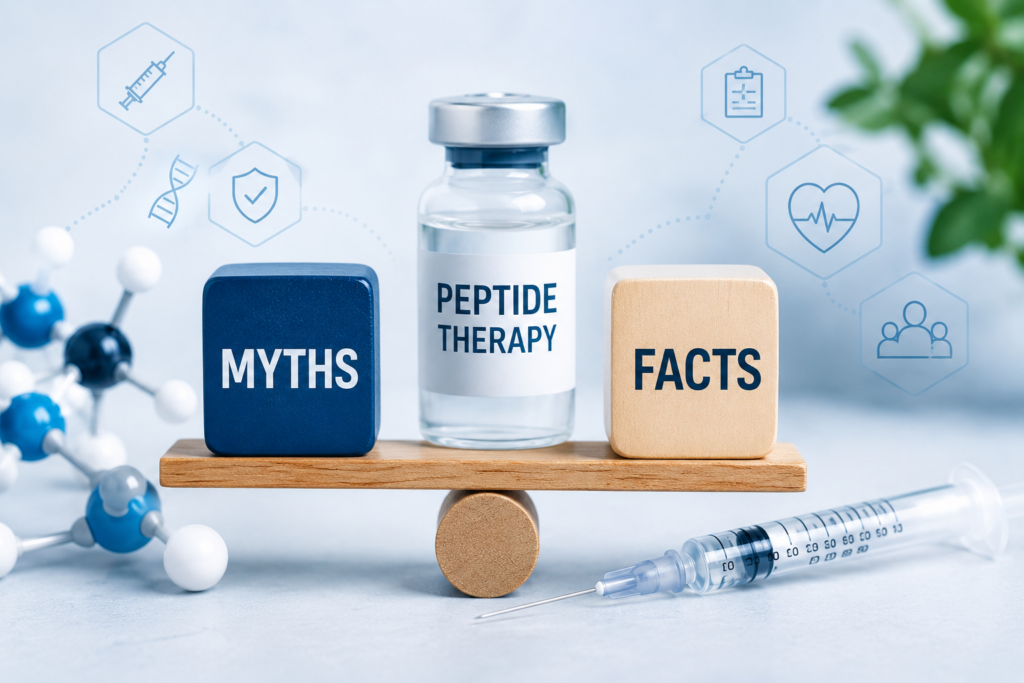
Peptide therapy is a medically supervised treatment that uses short amino-acid chains to support metabolism, tissue repair, and hormone balance. It works but only within limits the internet rarely mentions. It is not a shortcut, not a banned substance, and not something you should self-administer without a provider watching your labs. Below, every major claim about peptide therapy myths vs. facts gets checked against what’s actually true.
Here’s what most articles won’t tell you upfront: the loudest claims about peptides both the miracle stories and the horror stories, usually come from people who’ve never sat through an actual consultation. The real picture is far less dramatic, and far more useful. MVM Health provides medically supervised wellness care for patients across Pennsylvania, including Reading, Bethlehem, East Stroudsburg, Wayne, and Exton.
What Peptide Therapy Actually Is
Peptides are naturally occurring molecules your body already makes short chains of amino acids that carry signals between cells. They tell tissue to repair itself, regulate appetite, release growth hormone, or manage blood sugar.
Peptide therapy introduces lab-made versions of these same signals, under medical supervision, to support a function that’s underperforming. That’s a very different mechanism than most medications:
- A blood pressure pill blocks a receptor.
- Some peptides work by interacting with specific receptors and signaling pathways in the body.
That distinction is exactly why interest in peptides has grown so fast and why the misinformation grew right alongside it.
How Peptide Therapy Actually Works in the Body
This is the part most articles skip, and it’s the part that explains why so many myths exist in the first place. Peptides bind to specific receptors on cell surfaces, the same way a key fits a particular lock. Once bound, they trigger a chain reaction inside the cell telling it to produce more collagen, release stored fat for energy, increase growth hormone output, or reduce inflammation at an injury site.
Because each peptide targets a different receptor, no two peptides do the same job:
- Some act on appetite and blood sugar regulation.
- Some act on tissue and joint repair.
- Some act on growth hormone release tied to sleep and recovery.
This is also why a provider needs your bloodwork and health history before recommending one. The right peptide depends entirely on which system needs support not on whichever compound is trending that month.
Why the Myths Won’t Stop Spreading
Peptide therapy sits in an unusual middle ground. Some compounds have decades of clinical data behind them. Others are still being debated by regulators in 2026, as federal officials weigh loosening restrictions on previously banned peptides while some clinicians push back on the evidence gap.
That tension is exactly why so much of what circulates online contradicts itself. One post calls peptides a miracle. The next calls them dangerous. Almost nobody separates which peptide they’re even talking about. Here’s where that separation actually happens.
Peptide Therapy Myths vs. Facts: Quick Comparison Table
| Myth | Fact |
| All peptides are the same | Each peptide has its own mechanism, evidence level, and approval status |
| Peptide therapy is completely unregulated | Some peptides are FDA-approved; others are compounded under a separate framework |
| There are no side effects | Mild, temporary side effects are common; serious ones are rare but possible |
| It’s only for bodybuilders and athletes | Most patients use it for fatigue, weight, sleep, or recovery not muscle-building |
| Peptides replace regular medical care | Peptides support existing treatment; they don’t substitute for it |
| Results appear immediately | Changes build gradually over weeks, not days |
| You can safely order peptides online | Unprescribed peptides carry real risks from dosing errors and no monitoring |
| It’s just anti-aging marketing | Peptides also support blood sugar, joint recovery, immunity, and hormone balance |
| One peptide works for every goal | Different peptides target different systems matching matters |
| It’s always too expensive to consider | Cost varies by peptide and plan; some cases have partial insurance coverage |
Myth 1: “All Peptides Are the Same”
Fact: They’re not even close. Peptides are dozens of distinct compounds with different mechanisms and different levels of evidence behind them.
- GLP-1 peptides like semaglutide have extensive data for weight and blood sugar control.
- Growth-hormone peptides like sermorelin have decades of use for hormone deficiency.
- Others marketed heavily online for anti-aging or recovery have far thinner research supporting them.
Treating all peptides as one category, good or bad is where most confusion starts.
Myth 2: “Peptide Therapy Is Unregulated”
Fact: Half true, and the half that’s true is usually misunderstood. Some peptides are FDA-approved. Others are compounded through specialty pharmacies under a different regulatory framework entirely.
A peptide prescribed and monitored by a licensed clinician is not the same risk category as one bought online with no prescription. That gap is where most of the fear comes from.
Myth 3: “There Are No Side Effects”
Fact: Any treatment that changes body function carries some risk. Peptides included. Commonly reported reactions:
- Redness at the injection site
- Mild nausea
- Headache or fatigue while your body adjusts
Serious complications are uncommon under proper supervision but uncommon isn’t the same as never. A provider who tells you this upfront is doing their job correctly.
Myth 4: “This Is Only for Bodybuilders”
Fact: Rarely. Most patients asking about peptide therapy have far more ordinary concerns:
- Persistent fatigue
- Slow-healing injuries
- Stalled weight loss
- Poor sleep
- Age-related hormone shifts
A person managing chronic pain or a stuck metabolism is a far more typical candidate than a competitive athlete chasing muscle mass.
Myth 5: “Peptides Replace Regular Medical Care”
Fact: They don’t. Peptide therapy supports existing treatment physical therapy, blood sugar management, structured weight plans; it doesn’t stand in for any of them. Patients who treat it as a stand-alone fix are usually the ones left unsatisfied.
Myth 6: “Results Show Up Immediately”
Fact: They don’t, and here’s why that matters. Peptide signaling changes tissue repair and metabolism gradually, over weeks not overnight. Anyone promising fast, dramatic change after one or two doses is selling a timeline the science doesn’t support.
Myth 7: “You Can Just Order Peptides Online”
Fact: This is the one that actually causes harm. Ordering without a prescription means:
- No dosing accuracy
- No quality control
- No one monitoring what happens next
A licensed provider reviews your history, checks your labs, and adjusts your plan as you go. That oversight is the entire difference between a treatment and a gamble.
Myth 8: “It’s Just Anti-Aging Marketing”
Fact: Anti-aging is one use case, not the whole story. Depending on the compound, peptide therapy may also support:
- Blood sugar regulation
- Joint and tissue recovery
- Immune response
- Hormone balance
Reducing the entire category to a longevity trend ignores the patients actually using it for real, diagnosable issues.
Myth 9: “One Peptide Works for Every Goal”
Fact: This one shows up constantly in online forums, and it’s why so many people end up disappointed. A peptide chosen for weight management won’t necessarily help joint recovery, and a peptide chosen for sleep and growth hormone support won’t necessarily touch blood sugar levels. Matching the right compound to the right goal is the actual clinical work involved, not a detail to skip past.
Myth 10: “Peptide Therapy Is Too Expensive to Consider”
Fact: Cost varies widely depending on the peptide, dosage, and length of treatment and some peptides used for medically diagnosed conditions may be partially covered depending on your insurance plan. The only way to know your actual cost is a direct conversation with your provider’s office, not a guess based on someone else’s online post about a completely different compound.

Why Supervision Changes Everything
Every myth above circles back to one root cause: a peptide used without oversight behaves nothing like the same peptide prescribed and monitored by a provider. Dosage matters. Sourcing matters. Your existing health history matters.
That’s exactly what to check for in a wellness provider anywhere in Reading, PA someone who explains which peptide, why, and how progress gets tracked, instead of just writing a prescription and moving on.
Peptide Therapy vs. Other Common Treatments
Patients often ask how peptide therapy stacks up against options they’re already familiar with. Here’s a quick comparison:
| Treatment | How It Works | Monitoring Needed |
| Peptide therapy | Signals your body to produce more of its own hormones or repair proteins | Ongoing labs and provider follow-up |
| Traditional hormone replacement therapy | Adds a hormone directly into your system | Regular hormone-level checks |
| Prescription weight-loss medication alone | Suppresses appetite or slows digestion via medication | Periodic check-ins, often less frequent |
| Over-the-counter supplements | Unregulated ingredients marketed for general support | Little to no monitoring or oversight |
None of these comparisons make peptide therapy automatically “better”; they just clarify where it actually fits.
Who Actually Benefits From This
Patients considering peptide therapy in Reading, PA usually fall into one of these groups:
- Stalled weight loss despite diet and exercise changes
- Recovery from joint, muscle, or soft-tissue injury
- Hormone-related fatigue or slow healing
- Chronic pain patients wanting a coordinated recovery plan
- Age-related metabolic changes needing a medically guided option
If any of that sounds familiar, the next step is a conversation not an online order.
A Quick Safety Checklist Before You Start
Before agreeing to any peptide treatment, confirm these five things with your provider:
- The specific peptide name and its approval or compounding status
- The evidence supporting that peptide for your particular goal
- Your dosing schedule and how it may change over time
- How often you’ll be checked in on after starting treatment
- What side effects mean it’s time to call the office right away
If a provider can’t walk you through all five clearly, that’s a signal to ask more questions before moving forward.
Questions to Ask Before Starting Treatment
- Is the peptide FDA-approved, or compounded?
- What evidence exists for this specific peptide not peptides in general?
- How often will progress get monitored?
- What side effects are realistic here?
- Is this replacing other care, or supporting it?
According to the U.S. Food and Drug Administration (FDA), compounded products which include many peptides are regulated differently from FDA-approved drugs, contributing to much of the confusion surrounding peptide therapy.
Get a Straight Answer, Not Another Search Result
Every myth on this page comes back to the same fix: a real conversation with someone who reviews your actual health picture instead of guessing from a forum thread.
Book your consultation with MVM Health and find out which peptide, if any, fits your goals backed by a provider who explains the evidence, not just the sales pitch.
Frequently Asked Questions
Is peptide therapy safe?
Yes, when prescribed and monitored by a licensed provider who reviews your health history and adjusts dosing over time. Risk rises sharply without that oversight.
What’s the biggest myth about peptide therapy?
That every peptide carries the same safety profile. Some are FDA-approved with strong data; others are compounded or still under research each needs its own evaluation.
Does peptide therapy cause side effects?
Mild, temporary ones are common redness at the injection site, nausea, fatigue. Serious complications are rare under proper supervision but not impossible.
How long before results show up?
Most patients notice gradual change over several weeks, since peptides work with the body’s existing repair processes rather than forcing an instant shift.
Is peptide therapy only for weight loss?
No. GLP-1 peptides are widely used for weight and blood sugar management, but others support tissue repair, hormone balance, and injury recovery.
Are peptides legal in Pennsylvania?
Many are, when prescribed by a licensed provider through a properly regulated compounding pharmacy. Legal status varies by specific compound.
How much does peptide therapy cost?
Cost depends on the specific peptide, dosage, and treatment length, and may be partially covered by insurance for certain diagnosed conditions. Your provider’s office can confirm exact pricing for your plan.
How is peptide therapy different from hormone replacement therapy?
Hormone replacement adds a hormone directly to your system, while peptides signal your body to produce more of its own, a difference many providers consider when building a treatment plan.