
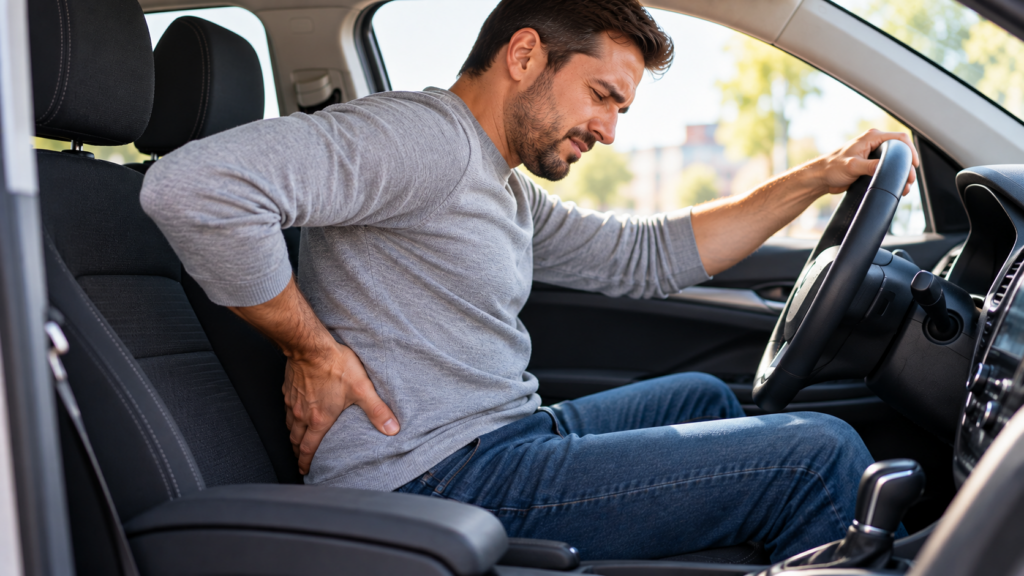
You pull into the driveway after another stop-and-go commute along I-270 or Cemetery Road, and by the time you’re out of the car, your lower back has already started to stiffen. Reach for something in the back seat and there’s a pull, a twinge, maybe a dull ache that lingers well after you’ve stood up and stretched. If this is a familiar part of your drive home, you’re describing a specific and well-understood problem not just generic “back hurt,” but pain that’s shaped by the particular way your body sits, braces, and holds still behind the wheel.
The Driving Position Is Different From Ordinary Sitting
Driving puts the spine under a distinct combination of stress that regular desk sitting doesn’t fully replicate, because the body is bracing, twisting, and vibrating at the same time it’s held in one position. At a desk, you’re mostly static. In a car, your foot is pressing pedals, your hands are gripping and turning the wheel, your torso is subtly rotating to check mirrors, and the entire seat is transmitting road vibration up through the spine. Add a seat that doesn’t quite match your body’s dimensions, and the lower back ends up absorbing load from several directions at once rather than just one.
A few driving-specific factors make this worse:
- Pedal-foot asymmetry — your right leg is more active than your left, which can subtly rotate the pelvis over a long drive
- Seat angle and lumbar support — many factory seats don’t support the natural inward curve of the lower back, so the spine slowly rounds
- Vibration transfer — road vibration is absorbed by the discs and muscles of the low back, especially on longer commutes
- Restricted movement — unlike a desk, you can’t easily shift position, stand up, or stretch mid-drive
- Bracing at stops and turns — sudden braking or quick maneuvers engage the lower back muscles repeatedly through a commute
None of these factors are dangerous in a single trip. The issue is repetition the same asymmetric load, commute after commute, day after day.

Why the Lower Back Takes the Brunt of It
The lumbar spine is often the region most affected by driving posture because it carries much of the torso’s weight while also remaining slightly flexed in a typical seated position. When you sit—especially in a car seat that flattens or reverses the lower back’s natural curve—the muscles, joints, and discs in the lumbar region have to manage sustained pressure with very little opportunity to change position. Compared with standing or walking, prolonged sitting can increase the load placed on the spinal discs and surrounding structures.
Over a 20- or 30-minute commute, that may not seem significant at first. But when the same position is repeated twice a day, five days a week, the accumulated stress can become meaningful. Limited movement, tight hips, poor lumbar support, and repeatedly reaching for the pedals or steering wheel can add to the strain, particularly when the seat is not properly adjusted for your height and body position.
This is different from back pain caused by a single heavy lift, sudden movement, or awkward twist. Driving-related lower back pain is often more gradual and cumulative. You might feel relatively comfortable after one short trip but begin noticing stiffness, aching, or discomfort after several weeks or months of following the same commute. Symptoms may become especially noticeable after longer drives, heavy traffic, or periods when you spend more time than usual behind the wheel.
That gradual pattern is one reason it can be easy to overlook driving as a contributing factor. If the vehicle, seat position, commute length, or route rarely changes, your lower back may be exposed to the same combination of posture, vibration, and limited movement day after day.
What Driving-Related Back Pain Tends to Feel Like
Back pain tied to driving usually shows a pattern connected to time in the seat rather than to a single movement, and commuters often describe it in similar terms. Recognizing the pattern can help you describe it accurately if you do see a provider.
Common patterns include:
- A dull ache that builds gradually during a commute rather than appearing suddenly
- Stiffness getting out of the car that eases somewhat after walking around
- Pain concentrated on one side, often linked to pedal-foot asymmetry or a rotated seating position
- Discomfort that’s worse on longer drives and better on short trips
- Tightness that radiates into the hip or glute on the side you tend to lean toward
If the discomfort stays a dull, localized ache that improves with movement and rest, that’s the pattern most people experience and manage with adjustments. If it starts to include tingling, numbness, or a sharp radiating pain down one leg, that points toward possible nerve involvement rather than simple muscular strain, and is worth mentioning to a provider directly.
Practical Adjustments Worth Trying First
Small changes to seat position, driving habits, and daily routine often reduce driving-related back pain without requiring medical treatment, especially when the pain is still mild and recent. These aren’t guaranteed fixes, but they address the mechanics described above directly:
- Adjust the seat so your knees sit level with or slightly below your hips, rather than higher
- Use a lumbar roll or cushion if the seat doesn’t support the lower back’s natural curve
- Move the seat closer so you’re not overreaching for the pedals, which can round the lower back
- Take short breaks on longer drives to stand, walk, and let the discs decompress
- Vary your route or errands timing where possible to reduce total consecutive seated time
- Strengthen core and hip muscles off-road, since better support around the spine reduces how much load the low back absorbs alone
For many commuters, these changes meaningfully reduce mild, driving-related discomfort within a few weeks. They’re a reasonable first step before assuming something more serious is involved.
Lower Back Pain After Driving? Consider an Evaluation
If lower back stiffness, aching, or pain keeps returning after your commute or prolonged time behind the wheel, it may be worth having your symptoms evaluated. Our pain specialists in Hilliard, OH can assess your symptoms, identify factors that may be contributing to your discomfort, and discuss appropriate next steps based on your individual needs.
When Driving-Related Back Pain Warrants an Evaluation
Mild stiffness after a long commute that eases with movement is common and not usually a sign of a serious problem. However, certain patterns suggest it’s worth having a pain specialist take a closer look rather than continuing to adjust the seat and hope it resolves:
- Pain that persists for more than two to three weeks despite seat and posture changes
- Discomfort that’s steadily getting worse rather than staying the same or easing
- Numbness, tingling, or weakness radiating into a leg
- Pain that disrupts sleep or limits daily activities beyond the drive itself
- Pain that starts appearing even on short trips or while sitting elsewhere, not just during commutes
Seek emergency care immediately if back pain is accompanied by loss of bladder or bowel control, sudden significant leg weakness, or pain following a collision or significant impact. Call 911 or go to your nearest emergency room; this article isn’t intended for urgent or emergency medical concerns.
Getting Evaluated at MVM Health in Hilliard
MVM Health’s Hilliard team evaluates driving- and posture-related back pain by first understanding your specific symptom pattern, rather than assuming a generic treatment path. A typical evaluation includes a conversation about when the pain started, how it relates to your commute or daily routine, a physical exam, and a discussion of next steps based on what’s actually found whether that’s a conservative approach or further diagnostic work.
MVM Health’s Hilliard, OH clinic is located at 3853 Trueman Court, Hilliard, OH 43026 and is open Monday through Friday, 8:30 a.m. to 5:00 p.m., serving patients throughout Hilliard and nearby communities including Dublin, Columbus, Upper Arlington, Grove City, Plain City, and Marysville.
If seat adjustments and short-term fixes haven’t resolved your driving-related back pain, schedule a pain evaluation at MVM Health’s Hilliard location.